Cyborgs, wheelchair flight and disability arts

Please note that this article includes names of Aboriginal elders who have died.

First published in Artlink, reprinted with permission.

Issue 44:3 Warltiti / Summer 2024

Issue Guest Editors: Ava Lacoon-Robinson, Claire Osborn-Li, Hen Vaughan

Managing Editors: Una Rey and Belinda Howden

Publication date: 1 December 2024 (Adelaide)

Cyborgs, wheelchair flight and disability arts

I’ve been thinking lately about the history of wheelchair design. The earliest depiction I know of is a vase painting, on an Attic red-figure kylix, of Hephaestus in a winged chariot, c. 525 BCE. Around the same period there are depictions of wheeled mobility devices (sans wings) in Ancient Greek and Chinese art. 

Self-propelled mobility devices are a relatively recent invention. Wheelchairs in the eighteenth and nineteenth centuries were slow, heavy, and designed to be pushed by an attendant. The modern self-propelled wheelchair was only made available in the mid-twentieth century. 

Two and a half thousand years after Hephaestus and his winged chariot, wheelchair users are finally capable of something like flight. Modern lightweight manual chairs are made from carbon fibre, titanium and aluminium. Mine weighs only seventeen kilograms. Uphill, it’s still a strain, hauling my weight and that of my chair. Downhill it feels like I have wings; I am skimming over the surface of the road like a bird over water.

Today, we are in a period of extreme technological acceleration. The growth of the internet, digital technologies, and artificial intelligence systems are rapidly transforming what is possible in our daily lives and art. 

Nobody is more intimately connected with these technological advances than disabled people. Many of us use mobility aids and prostheses that were only invented in the last decade. I use an external wheelchair power assist device (the SmartDrive MX2) that was only patented nine years ago. The control mechanism that I currently use was developed just last year. I write this essay from bed, on my smartphone, using dictation software.

Disabled people have always been at the forefront of technological innovation. Myoelectric and robotic prostheses, augmentative and alternative communication (AAC) devices, speech generating and recognition software, hearing aids and cochlear implants, and AI-generated captions are all relatively recent technologies that have had a massive impact on how we interact with the world.  It has never been built for us, so we must adapt and invent to live and thrive within it. 

We are cyborgs in the truest sense. 

In her 2018 essay The Common Cyborg, Jillian Weise criticises the metaphorical invocation of cyborgs in science fiction and academic theories. The use of the cyborg as metaphor ‘co-opts cyborg identity’, she writes, ‘while eliminating reference to disabled people on which the notion of the cyborg is premised. Disabled people who use tech to live are cyborgs. Our lives are not metaphors.’

The cyborg conditions of modern disability are reflected in our art, and in the art of nondisabled people, whose lives and practices are also influenced. Everyone experiences sickness, and everyone becomes disabled if we live long enough.

In the 1910s, groundbreaking Australian modernist artists Roy de Maistre and Roland Wakelin collaborated on paintings inspired by synaesthesia. De Maistre experienced lifelong health issues attributed to childhood tuberculosis. His disability prevented him from pursuing a musical or military career, but it gave him a unique perspective as a painter. De Maistre and Wakelin were not wheelchair users, but wheels–specifically colour wheels–were central to their artistic practice. The Art Gallery of New South Wales (AGNSW) collection holds a gadget that de Maistre invented and used for decades: a layered set of colour wheels, in which the colour spectrum corresponded to notes on a musical scale.

De Maistre and Wakelin are widely credited as the first artists in Australia to employ and exhibit pure abstraction in their art, notably in Colour in Art in 1919.  Their synaesthesia-inspired compositions, which they called “syncromies”, were attempts to visualise music in colour. To me, these paintings feel like depictions of the disabled world I want to live in: suffused with colour and light, unbound by the natural order but with its own internal rhythms. A veneration of the wheel and all that it generates.

Other Australian artists became disabled later in life. Jeffrey Smart, a renowned precisionist known for his satirical urban landscapes, used a wheelchair in his last years as an artist. His final work, Labyrinth, was painted from his wheelchair in 2011. Labyrinth depicts a lone figure lost in an endless high-walled maze. 

As a fellow queer wheelchair user, the painting feels like a secret, painful in-joke. Becoming disabled means having walls rise up around you wherever you go. Wheelchairs extend our mobility, but they cannot breach a built environment that excludes us. There is no escaping the labyrinth of inaccessibility. 

Labyrinth depicts the darkest aspect of the abled, disabling world. There is no light or hope in this painting, though perhaps there is a little dark humour. In Smart’s landscapes, everyone’s mobility is limited. Equal access inaccessibility.

Smart’s paintings are too lonely for me to dwell on for long. I find myself turning to different disabled visions, ones that centre joy, movement, protest, solidarity, and—above all—community. For someone like Smart, becoming disabled was an experience of profound limitation. For others it is an experience of transformation, an opportunity to confront the limitations of our humanity.

In many Aboriginal languages, there is no specific word for disability, because disability doesn’t set people apart. In societies with strong traditions of community care, everyone has different needs, and everyone’s needs are met by each other. In the 1960s and 1970s, Bundjalung and amputee artist Lester Bostock (1934-2017) was a pivotal figure in establishing Radio Redfern and, alongside Paul Coe, Gary Foley and Jenny Sheehan, founded the National Black Theatre. He often spoke about the “double disadvantage” of being Aboriginal and disabled. For Bostock, the antidote was community. He dedicated his life to community-led grassroots projects, including community radio, theatre and filmmaking.

Interdependent living, not independent living. Solidarity, not solitariness.

Yolŋu artist Dhambit Munuŋgurr similarly merges respect for tradition and community with experimentation and adaptation in her work. Munuŋgurr has been painting since the 1980s, but radically altered her practice after a car accident in 2007. She now uses a wheelchair.  Because she had trouble grinding traditional ochre pigments by hand, she received special permission from Yolŋu elders to use acrylic paints instead. Dhambit is now known for her signature use of brilliant blue in place of natural ochres on bark and larrakitj (hollow logs). For her, these colours evoke the sky, sea and earth. Most of her paintings are depictions of Yolŋu stories passed down from her family and ancestors.

Maōri dancer Rodney Bell spoke to the Sydney Morning Herald about his wheelchair aerial performance, The Air Between Us (2021-ongoing): “I have been gifted this vehicle of dance. I’m upside-down, my organs are moving, my body is swaying. I’m in touch with nature, I’m up in the air, I am where the birds live, what more could you ask for?”[1] Bell’s wheelchair isn’t something restrictive, but an agent of freedom and an extension of his body.

Bell’s performances are hypnotic and ethereal. When I saw him perform last year above the Tallawoladah Lawn in front of the Museum of Contemporary Art, I thought again of Hephaestus in his winged chariot. Unlike Hephaestus, Bell does not fly alone. In most of his performances he is accompanied by other dancers. In his aerial practice he is held up by intricate rigging; in the rest of his life, he is held up by community, by his disabled whānau. This is a reciprocal relationship, not an extractive one. On The Air Between Us, Bell said he was “excited to give back to the community, especially the ‘tangata haua’ — a Māori term that he translates to ‘our disabled people that lean differently in the wind.’”[2]

Wheelchair-using Afro-Caribbean choreographer, dancer, DJ and lawyer, Riana Head-Toussaint, similarly celebrates disabled movement languages in her work. Her artistic practice is experimental, multidisciplinary, and moves across various digital and physical formats. In her 2022 residency at Firstdraft, Sydney, she developed Animate Loading: 1.[3]She explored unconventional performance elements including sound design and audience activation to ‘create works that interrogate entrenched systems, structures and ways of thinking; and advocate for social change’, and rejecting ‘traditionalism and arbitrary formal notions of what art can be.’[4] From 2022 to 2024, Head-Toussaint has organised CRIP RAVE THEORY, an interstate party, proposition and political statement. Head-Toussaint describes CRIP RAVE THEORY as ‘a club night outside the club that draws on disabled/crip knowledge to create more intersectionally-accessible party spaces.’[5]

Earlier this year, I collaborated with Riana in Queer as in Crip, a project she curated for AGNSW. Myself and three other wheelchair users–Hanna Cormick, Kerri Shying and Sam Petersen–recorded ten minutes of spoken word performance. Kerri and I are primarily poets; Hanna and Sam are primarily artists. I consider all of them to be my tender comrades in queercrip resistance. Sam often talks about the power of art to reclaim space:

I like to permeate a space, make it my own, because I am not welcome in so many. I get inside, as much as I can, with myself and my fluids. I try to get inside your minds, and laugh, and scream.[6]

As modern technologies continue to grow and transform, so too will disabled communities and disability arts. As the global coronavirus pandemic continues, disabled artists are more vulnerable than ever, but our work adapts and thrives in crisis. We organise collaborative art projects over Zoom; we create accessible digital spaces; we build community both online and offline. 

Jillian Weise writes that ‘this feeling of trial-and-error, repetition and glitch, is part of the cyborg condition and, by extension, the disabled condition.’[7] Above all else, the cyborg survives; the wheel rolls forward.


[1] Rodney Bell quoted by Billie Eder, “’I am where the birds live’: Rodney Bell on twirling in titanium”, Sydney Morning Herald, 21 January 2023.

[2] Rodney Bell quoted by Ian Ruder, “Wheelchair Dancer in the Sky”, New Mobility, 24 January 2023.

[3] Animate Loading was first developed and presented as a part of the 2021 exhibition Concrete at Pari, in Western Sydney, curated by Rebecca Gallo and Kalanjay Dhir.

[4] “Riana Head-Toussaint”, firstdraft, accessed 21 October 2024.

[5] Riana Head-Toussaint, “CRIP RAVE THEORY”, fine print, Issue 29: Access, September 2022.

[6] Sam Petersen, artists website, access 21 October 2024.

[7] Jillian Weise, “Common Cyborg”, Granta 24 September 2018.

TO THE BODY UNORDINARY

This poem was published in APJ 14.1: WALKING, guest edited by Jake Goetz. You can buy a copy here.

TO THE BODY UNORDINARY

the doctor cracks jokes,

doesn’t have that twist to his mouth

that i have come to expect

nor the mantle of arrogance

while mispronouncing my condition

doesn’t say “maybe you’re just

anxious”—i am anxious

largely due to doctors 

who neglect the maxim Do no harm

parading bigotry as physic

saying “maybe you’re overthinking

it” or maybe it’s my imagination

& i try to imagine something else, 

a body without agony, 

a body that walks & stands up

without falling over, a body

with energy & substance, lacking 

joint laxity, spasticity, fragility, 

unaltered by hormone therapy, 

untargeted by eugenics, with an 

unabbreviated life expectancy

—a body that will never know the joy

of soaring down the hill, a body

that is still, that doesn’t spin or sway 

from side to side or soak up colour

& light, a body with quiet hands

that doesn’t contort or fall out of joint:

a slow, bipedal, confident body,

possessing limited mobility, 

no lithium-ion propulsion,

unradicalised, oblivious

& ignorant of all the secret pathways

(side entrances, goods & services 

elevators, hydraulic stair lifts,

jacaranda flowers littering

the long way round)

—none of which i explain

to the doctor, who says “normal”

in contrast to my body & then

guiltily amends to “typical”

at which i laugh thinking

how boring to be normal, how dull

& colourless a life

how unimaginable

JOYRIDE, from Raging Grace

This poem was first published in Raging Grace: Australian Writers Speak Out on Disability, edited by Andy Jackson, Esther Ottaway and Kerri Shying, 2024.

JOYRIDE was written as the third piece of a criptych (crip triptych) of poems about wheelchair joy. The first two poems, not included here, were written by Kerri Shying (HEY THERE LEGS ELEVEN) and Gaele Sobotte (WHEELING THE STICKY DELICIOUS). You can buy a copy of Raging Grace here.

JOYRIDE

Listen I said I’m hell on wheels

burning up the bitumen

I’m that vroom vroom mthrfckr 

that Tilite street fighter 

that acid green that sleek freak

lean mean meme machine

I’m that speed demon born 2 ride

that deadly sin that crip pride

that battleground that unsound

that rebel yell I’m hellbound 

I’m underground I’m thunder

& lightning I’m frightening bipeds

w that BEEPBEEP that tyre shriek

that too fast too young

I’m well hung high-strung 

yeah I’m that scream queen

that in-between seize the means

that high risk heart disease

uncomfortable mortality 

that eugenic disposability

emergency ward striptease 

hospital glam night shift

that fall risk that plot twist

stuck in the hydraulic lift

the grift the grind that grand design 

see u on the picket line 

I’m circling I’m rapid cycling

I’m that manic panic that 

aerodynamic that didactic 

that dialectical materialism

that trans contagion that 

survival mechanism

that narrative prosthesis

I’m spasticus autisticus 

I’m the lunatic the mutant 

the monster the mad bitch 

the noncompliant bad crip 

the fetish fuck the tokenism

yeah I get around I lie down 

I’ll throw down I’ll sing out

WHEELS UP STREETRATS LET’S GO 

watch out we’re revving engines

we’re revolving we’re in revolt

hey I said I’m revolutionary 

age of devolution baby

I said solidarity not charity

I said rise up bash back

Comrades listen I said

this poem kills fascists

I said sing out ye disenfranchised

wheelchairs of the world unite

the manual the motorised 

the rollators the sweet rides

the homefires resistance 

the sticks & stones the inpatients

the impatience the invalids 

the involuntary high vis

the dole bludger proletariat 

the sick cunts the slam dunks

the red flag union hacks

the ticking clock cardiacs

the ethical dilemmas the

queer hypotheticals

inflammatory radicals

the persecuted masses

black armband insurrection

retribution reparations

Listen

I said the revolution’s coming

GOOD CRIPS GO TO HEAVEN BUT GET STUCK AT THE STAIRWAY

This poem was initially published as a digital zine for Red Dirt Poetry Festival in 2020. The first few pages are attached below. You can read the full zine here and image descriptions here.

GOOD CRIPS GO TO HEAVEN BUT GET STUCK AT THE STAIRWAY
after Quin Eli

Be bad, love. Take that bad attitude
and forge it into armour. Turn chains
into chainmail. Take the rage and rancour
and make it plated bronze, brace your joints
in bitterness. Blaze apotropaic iron
out of acrimony, glare back at staring eyes.
Rebel and revolt. Forget that carceral logic,
be grassroots, be light and fire. Let your disabled body
be fierce and furious, let your disabled mind
be ardent and wild. Wrap steel around your heart
and let your heart stay soft. The life you have
is a life worth living. Be proud, love.
Be loud and unashamed. Fold fear into a shield,
let all of it reflect away. Don’t look back,
don’t dwell in regret. Let yourself seek redemption
without the tragic backstory, without justification
or explanation, without “what’s wrong with you”
or “what happened”. Let it happen.
Bite the hand. Demand, don’t ask.
If they care, they’ll fight beside you. Piss on pity
and inspiration, reject involuntary martyrdom.
Be that transgender menace, that lavender threat.
Be damned, love. You’re there already.
The world is burning. Take hell
and make it yours, be hell on wheels.
Be monstrous, be the bad example,
the bad influence, the bad cripple.
Be noncompliant. Speak in your own language.
Live fast, live strong. Fight for liberation
not assimilation. Remember solidarity,
stay strange, keep weird and queer,
and always channel anger into action.
You are loved and not alone. There is more than this
and more to come. Be joyous, my love, be bad.

Good Crips Go to Heaven But Get Stuck at the Stairway
after Quin Eli
Robin M Eames
Picture: a white genderqueer wheelchair user in a graffitied alleyway.
Text: Be bad, love. Take that bad attitude and forge it into armour. Turn chains into chainmail. Take the rage and rancour and make it plated bronze, brace your joints in bitterness.

image: colourful graffiti on a wall including the text ‘transphobes with no teeth’; a close-up photo of a brass microscope
                               Blaze apotropaic iron
out of acrimony, glare back at staring eyes.
Rebel and revolt. 

[image: a hand passing through flame; an x-ray of Robin’s cervical spine in flexion and extension, where their lip piercing is visible]
Forget that carceral logic,
be grassroots, be light and fire. 

[image: close-up of poppies; film photo of orange and yellow nemesia flowers]
Let your disabled body
be fierce and furious, let your disabled mind
be ardent and wild. 

[image: Robin wearing a colourful dress doing a wheelie in front of a graffiti-covered wall; a long exposure shot of a rainbow hoop, with colourful streams of light flaring out around a vague figure]
Wrap steel around your heart
and let your heart stay soft. The life you have
is a life worth living. 

[image: vibrantly coloured cardiac echoes of Robin’s wonky heart; eucalypts at dusk]

Picturing Medical History: ‘Ways of Seeing’ the Historical Medical Subject

A new collaborative article in Health and History, the journal of the Australian and New Zealand Society for the History of Medicine. Massive thanks to Effie Karageorgos for pulling this project together.

Robin Eames, Jordan Evans, Samantha Kohl Grey, David T. Roth, Lucinda Stormont-Sainsbury, Effie Karageorgos, ‘Picturing Medical Histories: “Ways of Seeing” the Historical Medical Subject’, Health and History 25, no. 2 (2023): 55–86. Available here or here (open access).

Abstract:
The image has been used by medical professionals for centuries to illustrate both usual and unusual processes of the body and mind. Images can expose or conceal medical truths, and in many cases are the only connection that exists between the historian and the frequently silent or silenced patient. In this paper, a group of historians each present and explore various methods of applying ‘ways of seeing ‘ or the ‘clinical gaze’ to a historical image from the medical world. Some images have been used to strategically serve the purposes of authority figures and silence the ill subject. Others reveal previously obscured patient’s voices. All present a perspective on the possibilities for analysing and assessing medical imagery from the past that moves beyond traditional understandings.

My section is titled ‘Dead/Effeminate’, a brief analysis of Edward Moate, institutionalised in Beechworth Asylum in 1884.

A page from a nineteenth century medical casebook. In the section for physical signs and symptoms of insanity, the record is mostly blank, but a clinician has written "Sex? } Effeminate", with the word Dead and an X added to the record later.
Patient record for Edward Moate. PROV, VPRS 7396/P/0001. Beechworth Asylum Case Books 1878-1892. Female casebook no. 2, entry 18, 24 July 1884.

Dead/Effeminate

Robin Eames

In 1884 a man named Edward Moate, living in Bright, Victoria, was arrested on a trespassing charge initiated by his former landlady. Moate was remanded for medical examination, and a day later was rearrested on a lunacy charge. The arresting police officer, Senior Constable Edward Shoebridge, gave a deposition explaining the altered charge: he did not suspect that Moate was mad, but rather ‘was suspicious as to whether Moate was really a man’.[i]

Moate had been working as a personal manservant to a surgeon, Doctor Benjamin Warren, and living in his household. Moate had good relationships with his community, and lived a generally quiet life, despite being well-known in his neighbourhood as ‘Ned the woman’ and ‘Old Biddy’.[ii] Dr. Warren was one of two local doctors who was usually responsible for signing lunacy certificates in Bright. When he died in 1884 after a long illness, Moate was arrested less than a fortnight later. At his lunacy trial, Senior Constable Shoebridge told the court ‘that the belief entertained by him and other residents of Bright and Omeo districts was that Moate was a female’.[iii]

Moate was taken to Beechworth Police Court, examined by two doctors (Dr. Henry Fox and Dr. David Skinner) and ultimately committed to Beechworth Asylum. Sergeant Shoebridge conveyed his doubts about Moate’s gender to the medical superintendent of the asylum, Dr. Deshon, ‘and was shortly afterwards informed that his suspicions were well founded as “Edward” Moate was undoubtedly a woman’.[iv]

Officially Moate’s diagnosis was one of religious mania.[v] After Moate’s story was widely publicised around the colonies, a few articles speculated that grief over Dr. Warren’s death may have been the cause of his insanity, but this was not reflected in the actual medical process. Moate’s lunacy trial, and the notes in his patient record, fixated on his gender transgression as the proof of his insanity.

The image at the focus of this article is taken from Moate’s file in the female casebook of Beechworth Asylum.[vi] In the section of his patient record noting the physical signs and symptoms of lunacy, the only comments included by his treating physician were ‘Sex ? Effeminate’.[vii] Within the visual framing of lunatic asylum records, Moate’s perceived effeminacy became the sole justification for a diagnosis of insanity, and for his subsequent involuntary incarceration. Nancy Rose Marshall notes that in the nineteenth century ‘artists and scientists both invested heavily in the faculty of sight’; the medical gaze, like the scientific gaze, was considered an ‘ostensibly objective form of looking’; of ‘seeing rather than analysing’.[viii] As the object of the medical gaze, patients were reduced to images. Andrew Scull refers to Shakespeare’s characterisation of lunatics as ‘pictures, or mere beasts’, noting that ‘the presumed need to segregate the mad from society’ was partly driven by a desire to make the spectre of madness invisible.[ix] By re-examining the relationship between lunacy records and visual cultures, we can discover new ways of seeing through (and analysing) the archives.

Reportedly Moate’s ‘effeminate appearance’ was also the reason why Shoebridge had arrested him in the first place.[x] Despite this, the Melbourne papers reported that ‘[p]revious to the detection of her sex at the asylum, no suspicion of her singular masquerade appears to have been entertained by anyone’.[xi] Moate’s gender was in fact a matter of common knowledge in his neighbourhood; a Beechworth newspaper noted that he ‘was attired as a man, and had for several years lived as such, but was believed to be a woman’.[xii]  The local correspondent for Omeo wrote that:

Her sex amongst the old residents was always a matter of doubt … She was only small, and her strength and endurance for a woman were something wonderful. In fact, she had the reputation of being a very good working man.[xiii]

This sentiment was echoed in the Omeo Chronicle by the local correspondent for Deptford, who was even more sympathetic:

I am very sorry for the misfortune that has fallen on poor “Ned Moate.” In common with others who lived on the Omeo road, I was well acquainted with him or her. Always civil, obliging and goodnatured, very honest and willing, nobody cared to press the question of sex on her, though the truth was more than suspected, it having leaked out on one of the very rare occasions, when she indulged in a glass too much. She bitterly resented any imputation on her manliness, and as she looked as like an old fashioned postboy as possible, and rode and groomed a horse well, she was allowed to have her own way unmolested.[xiv]

Gender transgression in the nineteenth century was frequently managed via vagrancy laws, but it was not unprecedented for it to form the basis of a lunacy charge.[xv] Edward de Lacy Evans, a Bendigo goldminer, had been institutionalised as a lunatic five years earlier, and discharged as cured after being forced to detransition. Indeed Moate was referred to in the papers as ‘another De Lacey [sic] Evans’ and ‘another female man’.[xvi] Moate’s lunacy charge essentially came about for two reasons: firstly because Moate had crossed gender categories in a way that violated colonial gender norms, and secondly because he had lost the protection of his employer. Moate’s strong social connections were possibly why he was arrested as a (potentially curable) lunatic patient, rather than fined or imprisoned as a vagrant, but they were not enough to prolong the tacit acceptance of Moate’s position in his community.

Once Moate became unemployed, unable to pay rent, and was no longer seen to be contributing positively to his community, he was removed via the systems that policed and punished disruptive aberrance. These systems did not render him in terms of aberrant femininity but in terms of aberrant masculinity – that is, effeminacy. According to the logic of the era, an effeminate man was a weak, inferior and unhealthy man. This was the rationale of eugenic theory, which had not yet been clearly defined in Australia but became increasingly popular from the 1890s and throughout the interwar period.[xvii] In 1884 there was already a strong perception that effeminacy was cognate with weakness, mental degeneration, and threats to white Australian futurity.[xviii] The label of effeminacy was apparently applied equally to transmasculine and transfeminine gender-crossers. In 1887, Carrie Swain was charged with vagrancy in Sydney for dressing as a woman, and described in the Evening News as both an ‘effeminate youth’ and ‘a detestable character’ who was ‘in the habit of perambulating the streets and parks after dark’.[xix]   Effeminacy was also a euphemism for same-sex male attraction, which may also have been a factor in the concerns surrounding Moate:

[Dr. Warren] was parted from his wife, and it is alleged in Omeo that the “intimacy” between the doctor and his servant was the cause of the separation, the doctor when “in his cups,” having stated his preference for “Old Ned.” Some few months ago, Dr. Warren was heard to say that “to his utter astonishment, he had just found out that ‘Ned’ was a woman.” The neighbours had believed this for years, and it was a common topic of conversation over the whole of the Alpine district, from Myrtleford to Omeo, and the boys there always teazed and twitted “Ned” with being a woman. Thus no surprise is felt at the discovery.[xx]

Moate’s unsanctioned transgression of contemporaneous gender norms was nevertheless allowed to continue for twenty years. This acceptance was both conditional and limited. Unlike his contemporaries Edward de Lacy Evans and Jack Jorgensen, who worked in mining and farming respectively, Moate did not transition into the productive workforce.[xxi] In his twenty years in Omeo and Bright, Moate worked as an assistant to the clerk of courts in Omeo and as a domestic servant to a well-respected physician. Unlike Evans and Jorgensen, Moate’s labour was not considered uniquely masculine to the point of provoking anxiety, but it also lacked the redemptive qualities of producing surplus value for the colonial economy. Moate was presumably protected by the social authority of his employers, rather than by the moral and social value assigned to his employment. When that protection disappeared, Moate was exposed to the judgement of the state.

As someone who had departed from his assigned position in the gendered order, Moate was categorised as an undesirable social deviant.[xxii] He was institutionalised not so much because he was sick, but because he was regarded as sickening to society. Social disorder was therefore rendered as medical disorder in order to remove, contain, and manage the threat of slippage between hierarchical social groups.

Moate refused to provide a female name or any information about his history before arriving in Victoria. With the infamous and recent example of Evans, Moate would have known that the pathway out of the asylum required detransitioning. He refused to take that path; all of his patient records were under the name Edward Moate, and he never became compliant to the satisfaction of the asylum staff. He died in Beechworth Asylum three years after his admission, under the name Edward Moate. 


[i] ‘Remarkable Imposture at Beechworth’, The Age (Melbourne), 25 July 1884, 5.

[ii] ‘Our Omeo Letter’, Bairnsdale Advertiser and Tambo and Omeo Chronicle. 31 July 1884, 2.

[iii] ‘Remarkable Case of Deception’, Weekly Times (Melbourne), 2 August 1884, 11.

[iv] ‘Remarkable Imposture at Beechworth’, The Age (Melbourne), 25 July 1884, 5.

[v] Patient record for Edward Moate. PROV, VPRS 7396/P/0001. Beechworth Asylum Case Books 1878-1892. Female casebook no. 2, entry 18, 24 July 1884.

[vi] Patient record for Edward Moate. PROV, VPRS 7396/P/0001. Beechworth Asylum Case Books 1878-1892. Female casebook no. 2, entry 18, 24 July 1884.

[vii] Patient record for Edward Moate. PROV, VPRS 7396/P/0001. Beechworth Asylum Case Books 1878-1892. Female casebook no. 2, entry 18, 24 July 1884.

[viii] Nancy Rose Marshall, ‘Introduction’, Victorian Science and Imagery: Representation and Knowledge in Nineteenth Century Visual Culture (Pittsburgh: University of Pittsburgh Press, 2021), 12.

[ix] William Shakespeare, Hamlet, Act 4 Scene 5, line 82, quoted in Andrew Scull, Madness in Civilisation: A Cultural History of Insanity from the Bible to Freud (London: Thames and Hudson, 2015), 188–190.

[x] ‘A Remarkable Case’, The North Eastern Ensign (Benalla, Victoria), 1 August 1884, 3.

[xi] ‘A Remarkable Case’, Advocate (Melbourne), 26 July 1884, 11.

[xii] ‘Beechworth Police Court’, Ovens and Murray Advertiser, 26 July 1884, 4.

[xiii] ‘Our Omeo Letter’, Bairnsdale Advertiser and Tambo and Omeo Chronicle. 31 July 1884, 2.

[xiv] ‘Our Deptford Letter’, Bairnsdale Advertiser and Tambo and Omeo Chronicle. 5 August 1884, 2.

[xv] Victoria’s Vagrancy Act of 1852 was mostly inherited from British legislation. The colonial laws were vague and flexible enough to be applied mostly at the discretion of the police. See also Suzanne Davies, ‘Vagrancy and the Victorians: The Social Construct of the Vagrant in Melbourne, 1880–1907’, PhD thesis, University of Melbourne, 1990; and Adrien McCrory, ‘Policing Gender Nonconformity in Victoria, 1900–1940’, Provenance: The Journal of Public Record Office Victoria, no. 19 (2021), online. https://prov.vic.gov.au/explore-collection/provenance-journal/provenance-2021/policing-gender-nonconformity-victoria-1900

[xvi] ‘Another De Lacey Evans’, Geelong Advertiser, 28 July 1884, 4; ‘Another Female Man’, Burra Record (South Australia), 1 August 1884, 2.

[xvii] See Diane B. Paul, John Stenhouse and Hamish G. Spencer (eds.), Eugenics at the Edges of Empire: New Zealand, Australia, Canada, and South Africa (Cham: Palgrave |Macmillan, 2018), 21.

[xviii] ‘Are the English Becoming Effeminate?’, Argus (Melbourne), 4 October 1884, 4. The anxiety around degeneracy was certainly not universal, and received pushback as early as it appeared in the 1870s. See ‘“Mozeck” and Human Degeneracy’, Yorke’s Peninsula Advertiser and Miners’ News (South Australia), 30 October 1874, 3.

[xix] ‘A Detestable Character’, Evening News (Sydney), 17 November 1887, 5.

[xx] ‘A Man Impersonator’, The Herald (Melbourne), 25 July 1884, 3.

[xxi] Jorgensen was a German migrant who also lived in the Bendigo district, working as a farmer in Elmore between 1873 and 1893. He was exposed as an ‘impersonator’ after his death, and posthumously appropriated Moate’s title of ‘Another De Lacy Evans’. See ‘A German de Lacy Evans at Elmore: A Female Mounted Rifleman’, Bendigo Independent, 6 September 1893, 3. See also Lucy Chesser, Parting With My Sex: Cross-Dressing, Inversion and Sexuality in Australian Cultural Life (Sydney: Sydney University Press, 2008); Lucy Chesser, ‘Woman in a Suit of Male: Sexuality, Race and the Woman Worker in Male “Disguise”, 1890–1920’, Australian Feminist Studies 23, no. 56 (2008): 175–194.

[xxii] The colonial lunatic asylum was a key structure in the policing and punishment of social deviance, alongside the courts and prison system. See also Alexandra Wallis, ‘The Disorderly Female: Alcohol, Prostitution and Moral Insanity in 19th Century Fremantle’, Journal of Australian Studies, 25 July 2019, online. https://www.tandfonline.com/doi/full/10.1080/14443058.2019.1638815

PRINCIPLES FOR VICTIMS AND OTHERS

This was written as part of Red Room Poetry’s collaborative project AUTHOR UNKNOWN.

You can read it on their website here, alongside its partner poem THE CEO MUST DO A THING, by the brilliant David Stavanger (cited here under the collaborative pseudonym Vacant Dragon à la Subverted Lips). PRINCIPLES FOR VICTIMS AND OTHERS is a found poem using excerpts of the the Queensland Mental Health Act 2016; David’s is a found poem using the National Disability Insurance Scheme Amendment Bill 2022.

PRINCIPLES FOR VICTIMS AND OTHERS

The patient is unfit to appear / in this Act

in absence of person / the person becomes an involuntary patient

when the person is admitted.

A person is presumed / a person only if it’s appropriate

Because of the person’s illness

the person does not have capacity to consent.

The relevant patient is observed, while kept in seclusion.

Information about the person must be recognised:

the person as if a reference:

the person is a member of a particular racial group

the person has a particular economic or social status

the person has a particular sexual preference or sexual orientation

the person engages in sexual promiscuity

the person engages in immoral or indecent conduct

the person takes drugs or alcohol

the person has an intellectual disability

the person engages in antisocial behaviour or illegal behaviour

the person is or has been involved in family conflict

the person has previously been treated for a mental illness

A person may have a mental illness

A person may have / human worth and dignity as an individual

The authorised doctor examining the patient

may be at risk of harming others.

An assisting clinician’s functions are limited

A person is to be encouraged

a person is to be provided

a person is to be helped

a person’s / special needs must be recognised and taken into account

for example, destroying it or giving it away

Care of a person means a reference to care of the person

recovery of a person means development of a person

When the person is discharged

Nothing in this Act makes the State liable.

VOCALISATIONS and SONG OF THE BIPED

These two were published recently in Bramble, issue 2, a journal by and for disabled creatives. You can read the issue here.

Vocalisations was written during lockdown.

Song of the Biped was an experimental poem written in the voice of a nondisabled person. I recognise that adopting the voice of a community I don’t belong to is controversial, but I am fascinated by the unique worldview of abled people: their curiosity, their obliviousness, their rigid adherence to convention. Several nondisabled people offered unsolicited consultation for this poem.

VOCALISATIONS

in the dream of evening i am afraid
of the not yet everything / of happening
too much or not enough / i am lonely
covered over with every star concealed
by city smog to which i contribute
every heartbeat i shall never recover
i am trying not to be too obviously crazy
in the zoom call & in the streets populated
by cop cars & dogwalkers / warned by the
neighbourhood whatsapp / i learn birdsongs
thru the urban wail of sirens / love & war
& calls of alarm / contact & separation / flight / hunger
seeking justice or solace / i am trying to be
a version of myself i can live with
hoping to live past 30 / for the ordinary noise of life
restraining expectations in the hope of hope
for not yet i give myself to my community
to love / struggle / solidarity / to something
i give myself to birds
to each unlikely dawn

SONG OF THE BIPED

I have a cousin who’s     handicapped
you know, special needs ???
??? directionally challenged ??? living with     access ????
how’d you end up in that thing?
How much does it cost and was it
a car accident? Carbon fibre?
Did the government pay for it
out of my taxes?      Do you work?
doesn’t seem cost efficient
is it permanent     or temporary?
Are you permanent     or temporary?
I’d kill myself if I had to live like you
– that’s a compliment     of course
to your resilience.      I broke my leg once
so I know what it’s like. It must be so hard.
Is it hard to get up hills? I just think you’re     inspiring
just think you’re     so brave for continuing
to get up in the morning (I wouldn’t)
And how do you get that into a car?
How do you     have sex? How do you
get up in the morning? Well     I’ll pray for you
here     I’ll help push you oh it’s no trouble,
I like to be useful     It’s fine, I think it’s fine
I won’t ask permission. I’m helping
Mind if I lean my bag on your shoulder?
Oh it’s no trouble     Hey, where’s your carer?
Why are you out here by yourself?
That’s not right. It’s so nice to see you out,
of course     You’re so brave     Not like those
dole bludgers. Were you born like that? Hey
I just want to thank you for being here –
I’ve never contemplated     my mortality
the way I do when I look at you
      Really makes you think

Wheelchair jousting

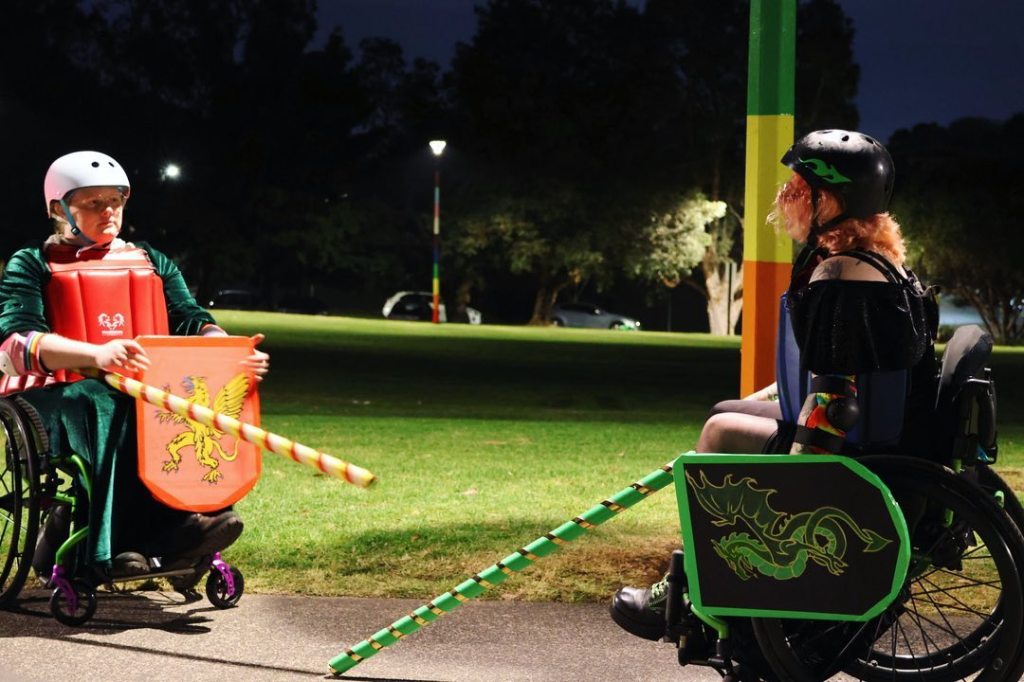
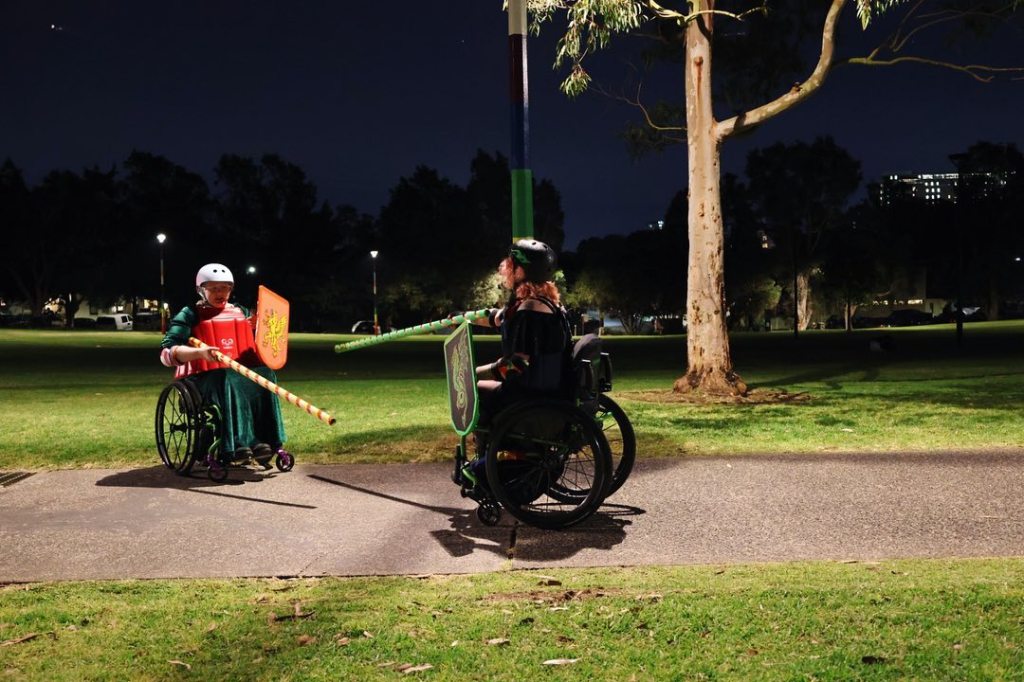
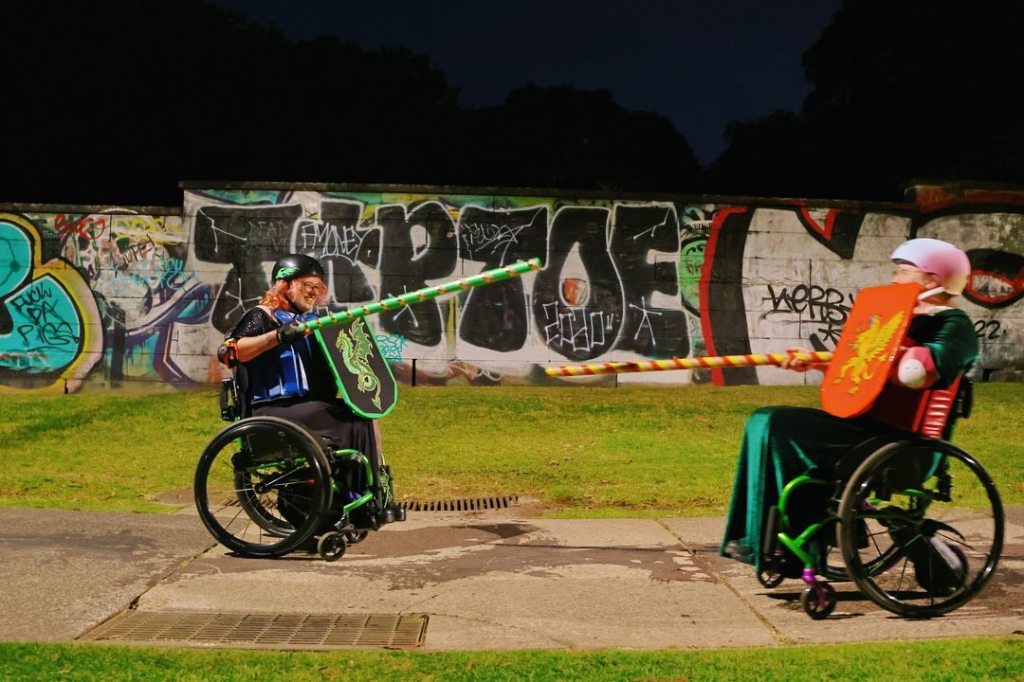
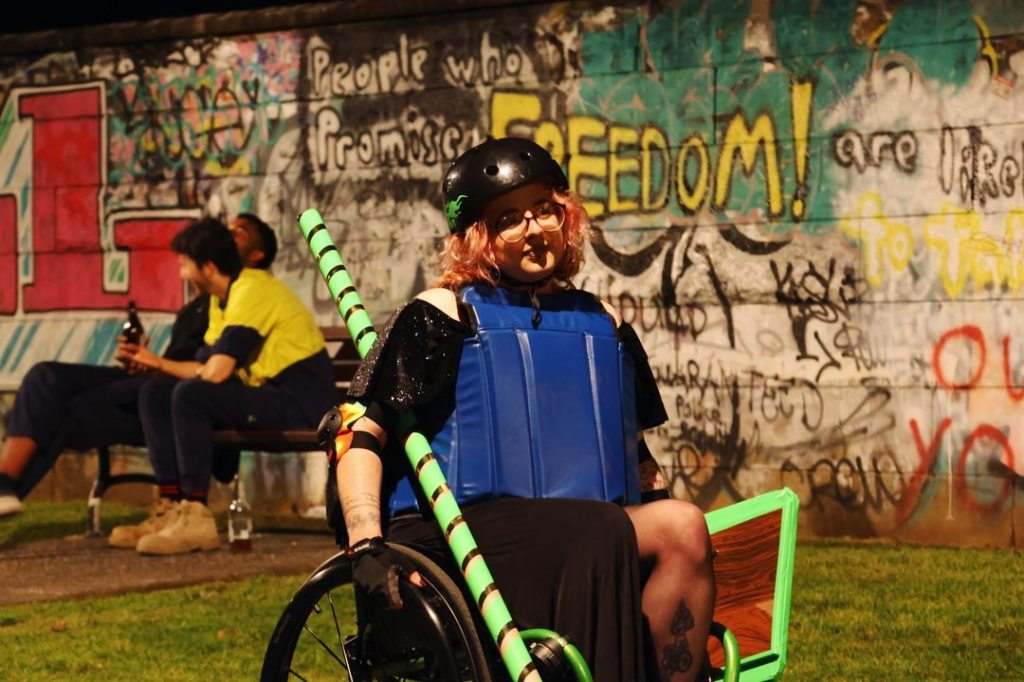
Last week I turned 30 and held a wheelchair joust. (Note: not historically accurate.)

With thanks to Caoimhe, my opponent, to Reverse Garbage for providing materials, and to Sam and Tess, for documenting the most fun I’ve had in my life.


Two wheelchair users duking it out, armed with cardboard lances and shields painted with gryphon and wyvern crests,

Robin on the offensive

Robin giggling, Caoimhe losing their shit

Robin waiting in the starting position, wearing padded armour and a bike helmet

Caoimhe, a Wiradjuri/Irish/Jewish wheelchair user, looking fierce as hell, holding a cardboard lance and red shield with a gold gryphon crest, in front of a mural of the Aboriginal flag.

Disabled Otherworlds

Commissioned essay for the Australian Centre of Contemporary Art, on Sam Petersen’s installation I’m still feeling it, exhibited in Overlapping Magisteria, 2020. Published in the exhibition catalogue.

Disabled otherworlds

For many of us, it is also a way of ‘being in the world’, a world that in many ways was not made for us and actively resists our participation. Through poetry, we are able to remake and reinvent that world.

– Jennifer Bartlett, ‘Poetry is a Way of Being in the World That Wasn’t Made for Us’[1]

Sam Petersen’s contribution to Overlapping Magisteria is a rebellion, a reclamation, a collision of worlds, and a vision of possible futures. It is also an exploration of body language, physicality, and of communication through touch. Like poetry, art is a language; a form of expression that transcends normative speech and speaks directly to the heart.

Petersen’s installation is sensual and fierce, evoking intimacy, yearning, rejection and resistance. In ACCA’s slick steel-walled foyer, tender pink plasticine enters through cracks and faults, filling the gaps and changing the nature of the space. The imposing urban architecture has its edges forcibly softened and made strange. Technology turns biomorphic, organic. The building, like the disabled body, becomes a cyborg amalgamation, its meanings altered and repurposed. As Jillian Weise notes, the metaphor of the cyborg has become so far removed from its literal manifestations that it has become a figure of science fiction rather than disability.[2] Petersen retains a sense of both.

The conflict between the organic and inorganic is one of many conscious ambiguities. Androgynous forms move through liminal territories and subvert binary entry points, destroying and recreating the site – or as Petersen puts it, quite literally ‘fucking the building’. The plasticine marked with fingerprints is simultaneously alien and intensely personal. Petersen is absent but present in all the spaces beneath and between, invisible and hypervisible. Plasticine, Petersen says, is ‘a great recorder of touch, and then that touch could be put on other things’.

Touch and physicality are central to this work, conveying passion and anathema, otherworldly visions infused with weird and beautiful eroticism. There are many tensions here, between the interior and exterior, between the self and the other. Petersen interrupts and disrupts the industrial geometry of the location, and substitutes features of an alluring, unearthly, but oddly anthropomorphic landscape. In a building characterised by its industrial aesthetic, Petersen reiterates that industry is not impersonal but the product of human labour, and reasserts the presence of disabled workers within a structure we are rarely considered to belong to.

The alterations are irreverent, even brazen, but not without seriousness; a sense of encroaching inevitability remains surging beneath the surface. Disabled art pours through the crevices of the Corten steel cladding with a kind of gentle inexorability. The fluidity of the shapes gives them the appearance of movement, a patient slowness. Petersen pulls the space into crip time, which Alison Kafer calls a ‘reorientation’; it is ‘flex time not just expanded but exploded; it requires re-imagining our notions of what can and should happen in time, or recognising how expectations of ‘how long things take’ are based on very particular minds and bodies … rather than bend disabled bodies and minds to meet the clock, crip time bends the clock to meet disabled bodies and minds’.[3]

The dissonant speeds and structures of crip time have perhaps never been more apparent than in the current moment. In a world reshaped by the global pandemic, disabled experiences of social isolation and exclusion are bizarrely universal; for once almost everyone is living on crip time. Petersen’s installation provides a return to abnormalcy, a reminder that the pre-COVID world was already in crisis. There are answers, but not exactly resolutions: Petersen’s response is one of mutation, adaptation, persistence and continuation in the face of obstacles.

Plasticine is an appropriate medium for a piece grappling with the malleability and multiplicity of space. The plasticine’s presence is both an embrace and an invasion. The urban city is a site of exclusion for disabled people, but it is also a site of rapid metamorphosis and expansion, and importantly a site of possibility. As a wheelchair user I often feel that I live in a different world to my bipedal peers. The map of the city I can navigate has different features: every staircase is a dead end, and every tall threshold becomes a wall. Like Sontag’s kingdom of the sick, the world of wheelchair users has porous borders, overlapping with the bipedal world but occupying different space.[4] I long for that other world as much as I resent – and resist – our exclusion from it. (In reply to Sontag, Sinéad Gleeson offers a sobering reminder: ‘the kingdom of the sick is not a democracy’[5]). Petersen’s work offers a possible alternative, intertwining love and longing with rage and defiance. In the world not made for us, Petersen suggests transforming the shape of the world itself.

[1] Jennifer Bartlett, ‘Poetry is a Way of Being in the World That Wasn’t Made for Us’, New York Times, 15 August 2018. nytimes.com/2018/08/15/opinion/10-poets-with-disabilities.html.

2 Jillian Weise, ‘Common Cyborg’, Granta online, 24 September 2018, granta.com/common-cyborg/.

3 Alison Kafer, Feminist, Queer, Crip, Indiana University Press, Bloomington, 2013, p. 27.

4 Susan Sontag, Illness as Metaphor, Farrar, Straus & Giroux, New York, 1978.

5 Sinéad Gleeson, ‘Blue Hills and Chalk Bones’, Granta, vol. 135, May 2016, granta.com/blue-hills-chalk-bone/.