contact yr representatives

The situation on Manus Island is getting really dire – refugees have been cut off from food, water, and electricity, and PNG immigration officials & their police commissioner have advised that they are disavowing responsibility for the safety of the refugees. They are not “illegal maritime arrivals”. They are refugees. We too came to this country by boat and without permission.

Call Peter Dutton, Minister for Immigration: (07) 3205 9977
Call Shayne Neumann, Shadow Minister for Immigration: (07) 3201 5300
Call Senator Penny Wong: (08) 8212 8272
Call Malcolm Turnbull: (02) 6277 7700
Call Julie Bishop: (02) 6277 7500
Call Bill Shorten: (02) 6277 4022
Call Tanya Plibersek: (02) 6277 4404

Don’t be hostile, let them know that you are calling about Manus Island (they are logging the number of calls), and that you support bringing the refugees here.

Love & solidarity.

LOVECRY/BATTLESONG

Recently one of my poems was a finalist in the Coalition of Texans with Disabilities’ Pen2Paper disability-focussed creative writing contest. I have reproduced the text of the poem here.

To my crip siblings, crip lovers, & crip mentors, to Laura Hershey and to Stella Young.

LOVECRY/BATTLESONG

To the crips I love and who love me in return
from a distance or intimately close during
long nights where neither of us can sleep for pain
waiting for morning and the pain that morning brings
I am here for you.

To the crips who have been crips for longer
than I have been on this earth and who
welcomed me with open hearts and fire
of loving purpose in ancient battle
I am here for you.

To the crips who taught me power
comes from pride and pride comes from practicing
until you are proud (and that you don’t get proud
by being shit: you get proud by practicing)
I am here for you.

To the crips who do not know that they are crips
but know only that they hurt that their bones ache
that their muscles are heavy and that their eyes sting
in sunlight after another unhelpful appointment
I am here for you.

To the crips institutionalised and imprisoned
whose first crime was living and continuing to live
abused and neglected in homes that are not homes
trapped not in their bodies but by bar and mortar
I am here for you.

To the crips who sleep overnight
in desk chairs and wheelchairs
in the offices of politicians bedecked with banners
reading FREE OUR PEOPLE
I am here for you.

To the crips that have houses but not homes
or homes but not houses or neither home nor house
forced to live on the kindness and sideways glances
of strangers on public transport
I am here for you.

To the crips whose lands have been stolen
whose waters have been stolen
whose children have been stolen and whose lives
continue to be stolen
I am here for you.

To the crips who dislocate their hips
doing full service sex work to pay for medical bills
incurred from dislocating their hips
while doing full service sex work
I am here for you.

To the crips fighting to love each other
and to have their love recognised on equal terms
with all who are in love without penalty or price
or public stigma or getting bashed on street corners
I am here for you.

To the crips fighting to love themselves
after being unloved by those who should have loved them
or after being hurt by those who professed their love
but only when it was convenient
I am here for you.

To the crips who are drowning
in cold oceans seeking refuge or drowning
on dry land as their lungs fill with fluid
while emergency registrars do not watch
I am here for you.

To the crips who are burning
who have burnt out and from the ashes
are rising again charcoaled and brittle
and bold and battle-hardened
I am here for you.

To the crips who died
after living and loving and fighting
and then falling
to be remembered with love and fight
I am here for you.

To the crips who aren’t dead yet
living and fighting and fighting to live
and loving each other and fighting
for each other
I am here for you.

To the young crips, the old crips, the
queer crips, the trans crips, the brown crips,
the black crips, the proud crips, the tired crips,
the warrior crips, the poet crips, the dead and alive crips,
I think of you
I love and fight for you
I am here for you.

HELL ON WHEELS

I wrote an article recently for Honi Soit about mobility accessibility, wheelchair users & our history at the University of Sydney, my beloved but dreadfully inaccessible uni.

You can read it here or on Honi Soit’s website.

I love my wheelchair. My wheels are rad as hell. My ride is a stylish manual MOGO Infinity with Round Betty wheels and a purple and green frame. The seat and backrest are specially fitted to my spine. Before I got my chair I was, for the most part, stuck at home. My joints dislocate daily, and while walking on dislocated hips is not impossible, it’s extraordinarily painful. There’s a reason my hospital patient records all have “high fall risk” at the top. But now that I’m not overexerting, trying to make my wobbly Jenga tower of a skeleton walk under its own power, I can go out dancing in my wheelchair and stay out for hours.

This said, making it through the world as a wheelchair user is exhausting. And please don’t misinterpret what I mean here: my wheelchair is a blessing. I used to stagger around on crutches and canes that dislocated my wrists and elbows if I used them for more than a few minutes, and leaving the house was such a tiring feat that I nearly absent failed my last undergraduate unit even though I was getting consistent HDs.

The problem is not the chair itself. The problem is that the paving stones on my street are broken to shit. The problem is that the four closest train stations to me are all inaccessible. The problem is that pushing myself uphill dislocates my shoulders, and power wheel attachments cost $9000. The problem is that I couldn’t access one of my honours seminars and my professor advised me to drop out rather than dealing with the lack of access.

In short, it’s not me, it’s USyd.

In five years of ambulatory study, I saw only two wheelchair users on campus. In my sixth year I have seen four more, mostly in the Assistive Technology Lab. I don’t know of any current staff members who are wheelchair users.

This is not statistically proportional. In Australia, 20 per cent of the population is disabled. The figure is 50 per cent in Aboriginal and Torres Strait Islander communities. Of course, not every disabled person is a wheelchair user. But enough of us are that our absence at the University is disquieting.

nma-44066052-001-wm-w685

Image: Jacob Baldwin, a white man in a red jacket, grinning wildly as he zooms past some trees on his red motorised wheelchair. Photo taken during the Ability Trek journey around Australia: 16,500 kilometres by motorised wheelchair from 1992 to 1996. Jacob Baldwin collection, National Museum of Australia.

USyd admitted their first female students in 1885: Mary Elizabeth Brown and Isola Florence Thompson. Our first self-identifying Aboriginal students were admitted in 1965: Charlie Perkins and Gary Williams. I don’t know who our first disabled student was.

According to the university’s archives, the first record that exists of a wheelchair-using student is Jacob Baldwin, who commenced study in 1975. Baldwin had cerebral palsy, which continues to affect one  in 500 Australians. In his application to study rehabilitation counselling at Cumberland College, he wrote:

“My qualifications to embark on such a course are almost nil, but the most important factor is that I feel very strongly, partly because of my own disability, about the unsatisfactory situation facing the handicapped people of today. A lot more has to be done by the able-bodied and the knowledgeable handicapped people in the community. Disabled people are human and more has to be done to introduce them into the ‘normal’ society and I, personally, wish to be in a position to help toward their acceptance and their general betterment.”

Cumberland College was not wheelchair accessible at the time. Baldwin had to wait outside the lecture theatre for other students to carry him and his wheelchair up the stairs. He was a skilled writer, but wrote by laboriously picking out letters on a typewriter one-handed. This prevented him from taking notes during classes, so he taped his lectures and his stepfather transcribed them. He later went on to become a founding member of People With Disability Australia, and was an early proponent of the ideas that laid the foundation for the National Disability Insurance Scheme.

The global disability rights movement had been rumbling underground for nearly a century at this point. When we are taught about Helen Keller in school, it is usually in the form of what the late and great comedian and writer Stella Young called “inspiration porn”: Keller is made out to be a helpless, animalistic youth, tragically prevented from communication by her deafblindness, and charitably aided by her teacher Anne Sullivan who taught her Braille and sign language. And yet Keller lived to 87 and became an outspoken suffragist and radical socialist.

2012-06-22-IMAGE_Helen_Strikers

[Image: HELEN KELLER CHEERS ACTORS’ STRIKE PICKETS. A newspaper clipping of Helen Keller joining the picket line at a protest of her own biopic.]

In 1949 she visited Sydney and founded the Gordon Davis House Youth Hostel in Stanmore. There were other disabled organisations constellated around the university grounds, but most of them were institutional in nature: the Weemala Home for Incurables; the Spastic Centre, now the Cerebral Palsy Association; the Callan Park Hospital for the Insane, founded in 1880, now the Sydney College of the Arts; and the New South Wales Deaf Dumb and Blind Institution, now the Institute Building, having been bought by USyd in 1961.

By the 1960s, disability activism had blossomed into a radical public movement in the United States. Like many other social causes, it began in student activism, namely at the University of California, Berkeley, where Ed Roberts and the Rolling Quads smashed their own curb cuts out of concrete, and at Gallaudet University, where Deaf students barricaded the campus with upturned buses in protest at the appointment of another hearing president. It wasn’t until the late 70s that disability activism came to the forefront in Australia. Joan Hume had graduated from USyd in 1969 as an abled student, then after breaking her neck in 1971, returned for postgraduate study as a wheelchair user. She wrote that in the 70s, “Universities, post-secondary training colleges and other forms of higher education actively discouraged enrolment of students with disabilities”.

Kath Duncan attended the University of Sydney from 1979 to 1980. For the most part she did not use her wheelchair on campus: “I stumped around more in those days than I do now,” she says. “Unless it’s changed heaps, it was abysmal for physical access.”

Of course USyd is hardly unique in this respect, then or now. Tertiary education in general is inaccessible on many fronts: poverty, rurality, Indigeneity, and disability are only some of the many factors that may keep otherwise eager students from enrolling in university. Sydney, specifically, is an accessibility hellpit. When visiting Melbourne I was flabbergasted by the functional public transport, the proliferation of decent curb cuts, and the generally higher commitment to meeting basic accessibility standards. In Melbourne, wheelchair users are frequent and unremarkable pedestrians. In Sydney, the sight of another wheelchair user is rare and kind of exciting.

I am a year younger than the Disability Discrimination Act (1992)(DDA), but the DDA is known to many in the disabled community as a “toothless tiger”. Unlike every other anti-discrimination law in Australia, the DDA has a clause for “reasonable exceptions”. This means that if a building, organisation, employer, or individual can prove that not discriminating against disabled people is too difficult, too expensive, or a cause of “unjustifiable hardship”, they are granted an exception to the law. Essentially this means that inaccessibility is the norm and disabled people are expected to sue if we want to access our environment on equal terms. Appealing to the DDA is rarely fruitful: more often than not claims are struck down and the complainant is forced to pay legal fees on top of that.

USyd violates the DDA in hundreds of ways everyday, but it’s impossible to file discrimination suits for every building on campus. For one thing, it would be even harder for disabled students to finish their degrees in between all the lawsuits, and for another thing, the courthouses are also inaccessible.

“I definitely limit my time at USyd due to its inaccessibility,” says Gabriel. “If I do have to go to USyd for whatever reason, I will opt to leave my wheelchair at home and instead use a cane or crutches because if I am using those, stairs and cobblestones are only a difficulty, rather than an impossibility.”

“I tried to get the lift upstairs to Manning Bar and spent a good 20 minutes waiting for the correct key to open the door, before being told that the security guard couldn’t find the correct key and I would have to take the stairs. That one instance of taking the stairs meant that I could not stand for at least the next three hours.”

“The stairs are a nightmare,” Saz agrees, stating that the University as a whole is “alienating as fuck”.

Accessible building codes have only been legally mandated since 2010, and it shows again and again:

“Of course we’re accessible, but we don’t have a lift or anything. We can carry you up the stairs though!”

“Yes we are wheelchair accessible, but you need to call up one of our staff members to unlock the goods and services entrance.”

“The performance is accessible, but the seats are built in so you will need to wheel in first and park your chair on the edge of the stage.”

“We are wheelchair accessible but there are several steps at the entrance.”

“We are accessible but not wheelchair accessible.”

“Yes we are accessible but we will need you to get out of your chair.”

“We want to be accessible but the building is heritage listed so we can’t install ramps.”

HELLONWHEELS

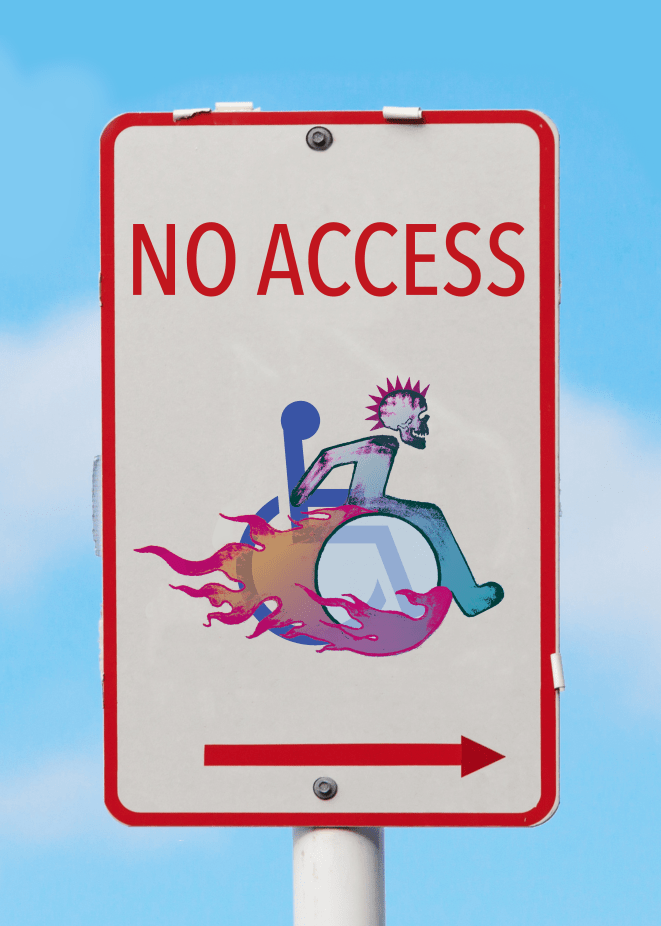
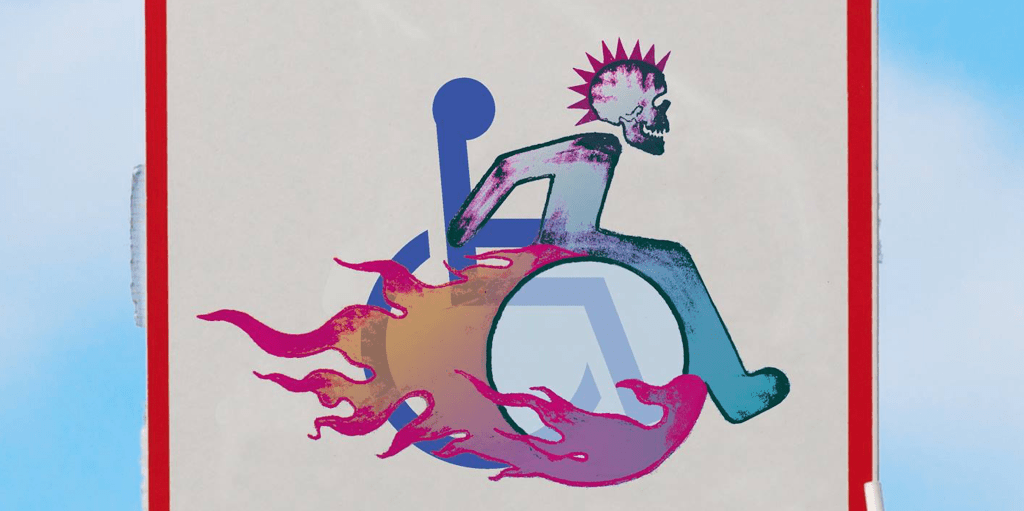
[Image: my own art, a digital collage of a street sign that says NO ACCESS with an arrow pointing to the right, beneath the traditional wheelchair symbol (the International Symbol of Access). Over the old symbol is a partially transparent glam punk rainbow version of the Accessible Icon Project’s self-propelling wheelchair symbol, with a spiky skull head and neon flames flaring out from the wheels.]

Noa Zulman, one of the current SRC Disabilities Office Bearers, says that “dealing day-to-day with disability in a professional environment becomes an all-consuming task”. Noa is determined, but her outlook is bleak. “As passionate about disability advocacy as I am, I really don’t think I could go into it professionally. It’s so draining and a constant demand.”

Still, even in a world where accessibility is the exception rather than the norm, USyd lags embarrassingly far behind when it comes to accessible infrastructure. It’s not for lack of goodwill. Well, actually, it is sometimes. This year, my professor refused to move his lectures to a wheelchair accessible building, despite having been informed about my access requirements before the start of semester. He had assumed I’d dropped out, because I hadn’t shown up to the room I couldn’t get into.

Ricky Buchanan graduated from La Trobe in 1998 and says little has changed since then. “People today are still fighting for exactly the same stuff we were fighting for twenty years ago” Buchanan says. “The technology has changed a bit, but the actual problems are basically the same: lecturers who don’t want to actually grant the accommodations that the disability services says you’re eligible for; disability services not understanding what’s actually needed; people feeling like accessibility is just ‘too hard’ and why should they change things for just one person.”

In theory, the University’s Disability Services should pick up the slack, but students are often left unimpressed.

“Like, sure, if you have a centrally timetabled classroom that doesn’t meet your requirements they might be able to help,” Anna explains. “But if you have two tutes back to back on opposite sides of campus, you’re shit out of luck.”

Elsa has similar qualms. “If you need something that wasn’t on the very short list of accommodations offered, it’s pretty much too bad,” she says. “Without the unit coordinator’s support, Disability Services’ abilities are severely limited. It’s exhausting and disheartening feeling like you constantly have to fight for accessibility. And it’s very isolating too.”

Jax Jacki Brown started studying at USyd in 2007, but left after a semester because the conditions were so dreadful. She visited recently for a guest panel during Disability Inclusion Week and told me that access is still “pretty poor”.

“People still routinely individualise disability as a personal problem and not systemic issue of rights and access and a fight against discrimination,” she says.

Many buildings do not have wheelchair accessible entrances, or wheelchair accessible amenities. Some buildings do not have elevators. There are several hydraulic wheelchair ramps, but they are usually either locked or broken, and nobody ever seems to know who keeps the key or how to contact them.

But these are not the only issues to contend with.

“The campus is huge and a nightmare navigating and cobblestones deserve to burn in hell,” says Flynn. “My bendy ankles hate cobblestones, especially since all the ones at USyd are on hills,” adds Sam. “I’ve twisted my ankles on them countless times.”

Other students agree: “murder on my ankles”, “lovely to look at, hell to ride over”, and “the bane of my life” are choice phrases. Evander tells me that “any form of bumps or cobbles were frustrating. I’d be carrying a hot soup for my lunch in one hand or on my knee and any bumps meant I got scalded a lot.”

Even the cobblestones, however, could be salvageable. “One of my favourite bits of inclusive design that I’ve seen was in the gågade (pedestrian-only city centre) in Copenhagen. The entire area is, of course, cobbled, but along each side of the street, they’ve placed a pair of tracks of smooth tiles, for wheelchair users to travel comfortably,” says Alex Haagaard, a writer and disability rights activist.

Online study is one option for students, but not an ideal one. “It’s really lonely doing online study,” says Hester-Henrietta. “A wheelchair means freedom, it means I can get out and do stuff, but online study cuts my contact from people. Chronic illness and disability meant that I lost a lot of friends or lost the opportunity to make friends in my teenage years as I had to drop out of high school, and I thought university would mean I’d be able to make friends, but because I can’t get around campus, I can’t make any now.”

For staff members, the situation isn’t much better. Dr Sheelagh Daniels-Mayes, a lecturer in Aboriginal education, is one of only eight blind and low vision academics in Australia. She estimates that she spends about 25 extra hours a week making up for inaccessibility. Turnitin and Grade Centre are both inaccessible for screen reading software, and PDF documents are “sheer hell”. And, unfailingly, the cobblestones. In order to avoid them, Sheelagh’s guide dog Nina insists on taking her on a roundabout route through the Law buildings.

The committee tasked with establishing a university in Sydney in the 1840s declared that they intended to create “a University which shall be accessible to all classes”. Later, in 1876, Dr Charles Badham claimed in his Commemoration Day address that the University of Sydney was “no inaccessible shrine for the glorification of a few”. And yet for the most part, this promised accessibility has failed to manifest.

The University of Sydney’s Disability Action Plan 2013-2018 aims to “incorporate the rights and opportunities of people with disabilities in all policies and planning” and to “provide an accessible built environment to everyone”. The plan also commits to developing a “best practice accessible environment” that is “not only based on meeting legislative requirements”.Such a sentiment is admirable, but falls a little flat considering that we don’t currently meet legislative requirements either. Perhaps the most promising aspect of the current Disability Action Plan is that it acknowledges that “we still have more to achieve in access and inclusion”, and acknowledges that accessibility is “both our legislative and moral duty”.

I love my university, but I cannot in good conscience recommend it to fellow disabled students. Hopefully this won’t always be the case. There are good people here. We are making our way forward, slowly and stutteringly, but we are getting there.

Still, if I end up losing it and taking a jackhammer to Eastern Avenue, Ed Roberts style, at least now you know why.


AFTER SAGAMIHARA zine

01.png

AFTER SAGAMIHARA
[image description: white ink sketches of cherry blossoms against a black background. The text AFTER SAGAMIHARA, centred, also in white.]

It’s finally finished! The 48-page zine AFTER SAGAMIHARA was created in collaboration with Australian disability organisations and activists to commemorate the first anniversary of the Sagamihara murders. To the survivors of the massacre and to disabled people worldwide, we share our love, our grief, and our hope for the future.

The zine was compiled by myself, with contributors including Samantha Connor, Quin Eli, Maggie Heynemann, Mizuki Hsu, Beck Kelly, Suzy Keene, Fayroze Lutta, and Wendi Wicks.

A file with image descriptions and all of the text from the zine is available hereAFTER SAGAMIHARA text with image descriptions (downloads as .pdf)

The zine itself can be accessed through issuu here. You can also download it as a .pdf here: AFTER SAGAMIHARA

Crip love & solidarity,
Robin

SUBBED IN: August 2017

20728796_1946232605657979_234026819028365372_o.jpg

[Image description: fuck lol where do I start. Text in kind of psychedelic retro font: SUBBED IN PRESENTS: HOW I MET YOUR CAN OF MOTHER. Evelyn Araluen, Bastian Fox Phelan, Robin Eames, Shareeka Helaluddin, Eliza Rite, Yiwei Chai, AJ Carruthers, Carlin Dally. Saturday 19th August, 5-7pm/$5 entry, Spunky Bruiser, 19 Foley St, Darlinghusrt 2010, http://subbed.in, https://sotosmith.com. An image of a benignly cheerful dolphin against a starry space photograph against some more excellent psychedelic nonsense.] 

Facebook event here. This is on in a couple of hours!!

Subbed in presents ‘how i met your can of mother’ 😊

literally drink in a night of literary readings with performances by:

Evelyn Araluen
Shareeka Helaluddin
Yiwei Chai
Eliza Rite
Robin Eames
Bastian Fox Phelan
AJ Carruthers
Carlin Dally
+ ~secret guest~

the venue and amenities are wheelchair friendly and fully accessible

all ages / alcohol-free

doors @ 5pm

entry $5 / free ibis temporary tattoo upon entry 😎

we’ll also be selling books, zines, art and broadsides by local creators

subbed in meets on the stolen land of First Nations People – the Cadigal Wangal people of the Eora Nation are the traditional custodians of the land. we pay our respects to elders past and present and acknowledge this land was never ceded, sold, or given up

see youse there

♥♥♥

http://subbed.in/
https://spunkybruiser.com/

This project is supported by the Writing NSW Grants Program, a devolved funding program administered by the NSW Writers’ Centre on behalf of the NSW Government and Arts NSW.

UNSPOKEN WORDS: a festival of writing

[image description: collaged text in pink orange & white on purple background, UNSPOKEN WORDS June 3-4 RED RATTLER: performances/workshops/panels/open mic reading space]

recently: UNSPOKEN WORDS, a festival of stories.

access guide available here.

the program is available here & lists the incredible lineup of artists and panels, including Hani Abdile, Evelyn Araluen, Maryam Azam, Stephany Basia, the Black and Deadly Women’s Poetry Circle, Emily Crocker, Winnie Dunn,  Stelly Gappasauress, Isaac Green, Dan Hogan and Stacey Teague of Subbed In, Lizzy Jarrett, Gabrielle Journey Jones, Holly Friedlander Liddicoat, Fayroze Lutta, Paige Phillips, Poesifika, Candy Royalle, Sea, Ella Skilbeck-Porter, Effy Marie Smith, Margarita Tenser, Thelma Thomas aka MC Trey, Bron Watkins, and Joseph Zane. the festival was MC’d and organised by Emma Rose Smith.

i ran 1 solo lecture, was on 2 joint panels, & read some of my poetry in the evening.

defining-ourselves-for-ourselves

[image description: white text on pink and blue background. PANEL – DEFINING OURSELVES FOR OURSELVES]

Defining Ourselves for Ourselves

Maryam Azam, Winnie Dunn, Robin M. Eames

11:15am – 12:15pm, main stage

Can we define ourselves by writing ourselves? We write ourselves, in whatever way possible for our individual needs, so as to create alternatives to single narratives. We need to see ourselves represented by people like us. Too many stories filter the whole world of experience through the gaze of abled cishet white people. This panel discusses the resistant power of telling our own stories, through the symbolic dialogue between living, visibility and text. We ask if and how we can write despite and beyond the dominating gaze of dual invisibility/hypervisibility that often occurs around politicised bodies.

CRIPPING THE LITERARY

[image description: white text on yellow and blue background. LECTURE – CRIPPING THE LITERARY: FINDING CRIP CULTURE]

Cripping the Literary: Finding Crip Culture, Learning Crip Language
Robin M. Eames

2:30 – 3:00pm, main stage

A fifth of Australians are disabled. So where the fuck are they? Are they at your poetry events? Are you reading their work? Are you listening to their communities? Are you fighting alongside them for their civil rights? If not, why? How do we change that? How can a gig, or space, or culture, be accessible (or not)? What are we overlooking? Why aren’t wheelchair users coming to our non-wheelchair-accessible events? How does disabled culture & community even manifest itself? For few answers & more questions, come to this lecture by Robin M. Eames, a disabled queertrans warrior poet who is only mostly dead.

queering-poetry

[image description: white text on pink and blue background. PANEL – QUEERING POETRY: WRITING OURSELVES INTO EXISTENCE]

Queering Poetry: Writing Ourselves Into Existence

Margarita Tenser, Isaac Green, Robin M. Eames

5:00 – 5:45pm, main stage

Three trans, queer, & disabled panellists speak about queering poetry, trans retrohistories, art & intersectional identity, living in ill-fitting worlds & bodies, finding ourselves in stories not made with us in mind, and writing ourselves back into the narratives.

unfinished-business-1

[image description: white text on pink and yellow background. PERFORMANCES – UNFINISHED BUSINESS]

UNFINISHED BUSINESS

Doors open (and dinner served) from 6:30, performances start 6:45. Main stage.

Hani Abdile, Winnie Dunn, Isaac Green, Robin M. Eames, Lorin Elizabeth, Dan Hogan, Elizabeth Jarrett, Gabrielle Journey Jones, Ella Skilbeck-Porter, Margarita Tenser, Auslan Stage Left

Come one and all to the biggest session of Unspoken Words! Hosted by the wonderful Lorin Elizabeth, this night will feature poetry readings by Winnie Dunn, Isaac Green, Robin M. Eames, Dan Hogan, Elizabeth Jarrett, Gabrielle Journey Jones, Ella Skilbeck-Porter and Margarita Tenser.

Hani Abdile will then present Absent Souls: A conversation with imprisoned souls. This new performance will be accompanied by a Q&A session and Hani’s performance of her own poetry.

This session will feature live Auslan interpretation thanks to Auslan Stage Left!

Dinner will be available thanks to Parliament on King, the social enterprise caterer. Beautiful food made with love. Proceeds from the catering are reinvested into hospitality training programs for locals with asylum seeker / refugee backgrounds at the King St café.

poster
[image description: event poster with a not-quite-complete list of artists, in the style of the featured image of this blog post, described above]

the festival was held at the Red Rattler Theatre, on the stolen lands of the Gadigal Wangal peoples of the Eora nation. sovereignty has never been ceded. always was, always will be Aboriginal land.

i really can’t emphasise enough how utterly awed, delighted, & proud i felt to be sharing a stage with such powerful & beautiful artists, & to have the chance to listen to their words. we did something really special last weekend & it gives me hope.

CRADLE THE SEED

[image description: Tahlia Day’s wonderful cover art for the Strange Horizons 1 May 2017 issue; an abstract greyscale piece of rippling currents and dotted lines in beautiful swirling patterns, something like looking from above at a topographic map of a storm.]

I had a poem published in Strange Horizons recently. You can read it on their website here, in the 1 May 2017 issue. They’re a wonderful source of diverse & nuanced speculative fiction and there are some beautiful pieces published alongside mine in the same issue. I wrote CRADLE THE SEED last year, while in a dark place that I am not entirely sure I have escaped from. It’s a poem that tries to be many things at once – a plea for help, a prayer to dead gods, a premature requiem for myself, an attempt at coming to peace with my death & regaining hope for my life.

The poem is dedicated to Jess Jacobs, a professional patient advocate and health innovator. She had EDS and she died last year at the age of 29. One of her last blog posts ended with an image bearing the text ANTES DE MORIR QUIERO VIVIR, the translation of which she directed towards a colleague in a postscript. “P.S.” she said: “Before I die, I want to live.”

Gerhard Mantz, “Personal Risk”, 2009

Response to a lecturer’s reluctance to provide disability accommodations, and some thoughts about rip currents

An article from The Chronicle of Higher Education has been making the rounds this week, authored by professor of psychology Gail A. Hornstein. To quote Alice Wong of the Disability Visibility project, Hornstein’s piece – titled “Why I Dread The Accommodations Talk” – is, well, “a dumpster fire of an article”.

Professor Hornstein teaches at Mount Holyoke College, a liberal arts college for women in Massachusetts. According to the college’s website, “Mount Holyoke women build robots, stand for social justice, and climb mountains”, and the college asks only that their students be “smart, determined, and willing to embrace change”. Nowhere on their website do they state the fine print: that their students are expected to be abled, or at least to overcome the infrastructural challenges of disability alone and without support from their tertiary educators.

Hornstein’s complaints are nothing we haven’t heard before. She begins the article by describing a disabled student of hers: “not confrontational, but not exactly friendly, either”; wearing an “old black motorcycle jacket and punk haircut”, “avert[ing]” her gaze”, speaking in “a flat tone”, and “mumbl[ing]”. In contrast, Hornstein “relaxes into [her] chair” and “look[s] directly” at her student. If Hornstein is sharing these details in an effort to humanise her student, she fails miserably: this is a textbook stigmatised description of millennial mental health. We know that the issue in question is mental health and not physical because that’s the point of Hornstein’s article.

Although in the USA students are not legally required to disclose their disabilities in order to receive ADA-mandated accommodations, Hornstein takes it upon herself to outline the ways in which “mental-health [sic] problems differ from many physical disabilities”, are dealt with in “overly broad and vague criteria”, and are “variable” (Hornstein seems unaware that physical disabilities are also frequently variable).

Perhaps Hornstein hasn’t read the sections of the ADA relating to eligibility, in which “disability” is defined as

A physical or mental impairment that substantially limits one or more of the major life activities of such individual.

The definition of “disability” shall be construed broadly in favor of expansive coverage, to the maximum extent permitted by the terms of the ADA. 

(1)  Physical or mental impairment means:

    • (i)  Any physiological disorder or condition, cosmetic disfigurement, or anatomical loss affecting one or more body systems, such as: neurological, musculoskeletal, special sense organs, respiratory (including speech organs), cardiovascular, reproductive, digestive, genitourinary, immune, circulatory, hemic, lymphatic, skin, and endocrine; or
    • (ii)  Any mental or psychological disorder such as intellectual disability, organic brain syndrome, emotional or mental illness, and specific learning disability

(2)  Physical or mental impairment includes, but is not limited to, contagious and noncontagious diseases and conditions such as the following: orthopedic, visual, speech and hearing impairments, cerebral palsy, epilepsy, muscular dystrophy, multiple sclerosis, cancer, heart disease, diabetes, intellectual disability, emotional illness, dyslexia and other specific learning disabilities, Attention Deficit Hyperactivity Disorder, Human Immunodeficiency Virus infection (whether symptomatic or asymptomatic), tuberculosis, drug addiction, and alcoholism.

(3)  Physical or mental impairment does not include homosexuality or bisexuality.

Hornstein then escalates the matter even further: “faculty members”, she writes, “need to respond appropriately and help students to learn what’s a crisis (and what’s not), and to understand when it is reasonable to ask for the course structure to be changed or for expectations to be modified (and when it’s best to try to cope on one’s own).”

Let’s allow that to sink in for a moment. Hornstein’s student has come to her with legally-issued accommodations for a documented mental illness. For those unfamiliar with the process of diagnosing, documenting, and requesting accommodations for mental health conditions, I can tell you now that it’s hellish. Any student who has access to disability accommodations has already been through an absurd amount of diagnostic bureaucracy in order to get to that point – bureaucracy that’s made even harder if, for example, you have a disability that interferes with your executive function, ability to make or keep appointments, capacity to make phone calls, chase up referral forms, or explain intimate details of your life to various medical and authoritative bodies.

Hornstein’s student’s request is very simple: she has panic attacks and has been granted extended deadlines in the event that her disability interrupts her studies. This is in accordance with the Americans with Disabilities Act, which states that:

Any private entity that offers examinations or courses related to applications, licensing, certification, or credentialing for secondary or postsecondary education, professional, or trade purposes shall offer such examinations or courses in a place and manner accessible to persons with disabilities or offer alternative accessible arrangements for such individuals.

…Any private entity that offers a course covered by this section must make such modifications to that course as are necessary to ensure that the place and manner in which the course is given are accessible to individuals with disabilities.

Unfortunately for Hornstein’s student, instead of reassuring her that her disability accommodations will be provided as is required by law, Hornstein – rather bafflingly – explains that her course has a “fast pace” and that her student would “be at a significant disadvantage if [she] missed a test”. (…Rather the point of needing legal accommodations, no?) Instead of telling her student that she will comply with the law, Hornstein says that she does not provide make-up exams in her course, and asks what might be the most insulting question ever asked of a student with panic disorder: “What do you usually do to calm down before an exam?”

“What do you usually do to calm down before an exam?”

Yikes.

If I were Professor Hornstein’s student, and in response to my request for legal accommodations she had asked me, essentially, “Have you thought about calming down?”, I may well have laughed in her face. Or quit the course right there. Or reported her to my university’s Disability Support Services.

Anyone who has documentation and accommodation requests has already got all the coping skills, all the strategies, all the tools, & they’re damn resilient just to get that far in the first place. It’s condescending and a fundamental misunderstanding of the way panic attacks work.  Like – oh shit, it hadn’t occurred to me to just STOP being mentally ill! No one’s ever suggested that before! So fucking helpful!

I’ve been having panic attacks since I was a child. I’ve been getting psychiatric and psychological help for them for the last five years. I still get panic attacks. Sometimes they occur in response to easily-identifiable stimuli and sometimes they come seemingly out of nowhere. My heart beats irregularly and very fast, I experience dyspnoea (shortness & irregularity of breath), my whole body breaks out in a sweat, I have hot and cold flushes, my chest feels tight and painful, I might blush bright red or go dead pale, I shake like a stick insect in a hurricane, I feel numb, dizzy, tingly, my throat feels choked, my limbs feel weak, sometimes my vision goes dark or blurry, I feel nauseous and sometimes throw up, and I often experience dissociation, derealisation, or depersonalisation. Usually I end up sobbing my guts out.

Like many people who experience panic attacks, I often worry about “losing control” or “going crazy” (note: “crazy” is often considered a slur, or at least a remarkably rude descriptor, in neurodivergent communities). Unlike many people who experience panic attacks, I am lucky enough that I have never mistaken a panic attack for a heart attack – possibly because I have actual heart attacks to compare them to (I have a bicuspid aortic valve and an ascending aortic aneurysm, and have frequent emergency episodes of various kinds of cardiac nonsense.) For Professor Hornstein’s benefit, I can quite happily report that panic attacks can be every bit as debilitating, painful, and terrifying as heart attacks. Sometimes my panic attacks last under a minute, and sometimes they can last hours. Generally they will last between twenty to forty minutes. (For those who might find it useful, you can download a copy of the Panic Disorder Severity Scale here, and you can access the Panic and Agoraphobia Scale here.)

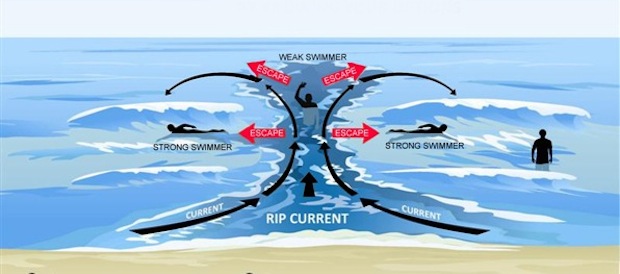
Once I am in the throes of a panic attack there is very little that I can do except ride it out. In that respect they’re very much like rip currents. Rip currents are narrow, extraordinarily powerful currents that are easy to spot if you know what you’re looking for, but fiendishly difficult to recognise if you don’t. My mother volunteered as a lifeguard when we lived on the coast, so for a couple of years every Sunday my siblings and I were enrolled in the junior surf lifesaving program. There are three ways to escape a rip: swim between the flags where the lifeguards are watching, hold your arm up straight & wait to be rescued; swim sideways away from the pull of the water, parallel to the beach, until you escape; or relax, keep your head above water, and wait for the current to eventually bring you back to shore. The worst thing you can do if you’re caught in a rip is panic and try to swim straight back to shore; the rip will pull you rapidly away from the beach and you’ll exhaust yourself trying to fight the tide. Rip currents kill more people on average in Australia than bushfires, floods, cyclones and sharks combined.
How-to-escape-a-rip

[Image description: anatomy of a rip current, with routes of potential escape.]

Hornstein is the lifeguard here. Her student was caught in a rip current and held her arm high for assistance, as she should be able to expect when swimming in a lifeguard-patrolled area. And yet instead of paddling out to rescue her, Hornstein left her student to fend for herself, with the justification of encouraging strong swimming. But not everyone is a strong swimmer, and you don’t become a strong swimmer by flinging yourself into a rip and hoping for the best.

According to Hornstein, her student’s response was as follows:

She mumbled a few things, and we talked a bit longer, but little concrete guidance emerged.

The term moved along, and I saw her each week in the back row of the lecture hall, but she never again came to my office. The TA of her lab section said Lee never missed a deadline and was doing well. I didn’t give her specific advice, nor did I ignore the reality of her problems. Instead, I conveyed confidence in her capacity to succeed and to come up with strategies to manage her difficulties. I have no idea if she still suffers panic attacks, but she didn’t miss any deadlines and got a high grade in my course.

It sounds like Hornstein’s student made it out of the rip alive – maybe because she’d been caught in rips before and knew what to do, or because a nearby swimmer noticed her distress and helped her out. Maybe she gave up and relaxed into the current, hoping to at least stay awake & above water for as long as possible, only to get lucky and be brought back to shore by happenstance, depending on the shape of the beach. Either way she was put in a terrifying position, denied legal aid, & forced to struggle her way out while being told it was building moral fortitude. Hornstein counts this as a success. But how many other students have drowned?

You can’t fight the whole ocean alone.

Hornstein, naturally, is convinced that her negligent approach is actually what’s best for her students. She describes herself as “an outspoken ally of many disability-rights activists” who has “taught and written about mental health for 40 years”. And yet she continues to betray her lack of understanding or compassion toward disability & disabled lives with every subsequent paragraph. Frankly, if this is the mindset of the last 40 years of mental health academia, no wonder it’s in such a sorry state.

“People have the right to behave oddly”, she claims, and as an example: “I once had a student who did not look directly at me or any other member of that 15-person seminar for the entire semester. I’ve had students who made strange head movements in class because they were hearing voices.”

This is not “behaving oddly”. It’s deeply, insidiously ableist that Hornstein was examining her students’ body language to this degree in the first place, that she considers this worthy of note, let alone that she considers herself super progressive for tolerating it. A very common hallmark of autism is significant discomfort making eye contact. ABA (Applied Behaviour Analysis) therapy, which has been rightfully called out in many forums as being horrifyingly abusive, holds forced eye contact as one of its main tenets. Sparrow Rose at the blog Unstrange Mind describes witnessing an instance of ABA therapy in action outside a behavioural clinic:

A mother and father came out of the clinic with a little girl, around 7 years old by my best guess. Mother said, “Janie (not the actual name), look at me.” Janie didn’t look at her mother. The mother said to the father, “you know what to do,” and the father took hold of Janie and turned her head toward mother, saying, “look at your mother, Janie.” Janie resisted, turning her head away and trying to pull out of her father’s hands.

Mother crouched down and Father lifted Janie’s whole body up, laying her across Mother’s knee, face up. “Look at your mother, Janie,” father said. “Look at me, Janie,” Mother said. Janie began to whimper. Her body was as stiff as a board. Father held her body firm and Mother took hold of Janie’s head, “look at me, Janie,” Mother said.

I was glued to the sidewalk. I didn’t want to see any more but I couldn’t look away, couldn’t walk away. Janie began to moan and thrash her body. Father’s hands held her body steady as she kicked and flailed. Mother’s hands held Janie’s head steady. Both kept urging Janie to look at her mother. Janie’s moans turned to screams but neither parent let her go.

Finally, Janie’s entire body went limp with defeat. She apparently made eye contact because Mother and Father began to lavish praise on her. “Good girl, Janie. Good eye contact. Good girl. Let’s get some ice cream now.” Janie’s limp body slid to the sidewalk where she lay, sobbing. Father picked her up and carried her to the car, the whole way praising her submission. “Good eye contact, Janie.”

I hate making direct eye contact. It makes me feel queasy and hypervisible, like a stranger holding a hug for too long. I can fake it enough to get by but it’s unpleasant. I feel very sad at the thought of my lecturers taking note of whether or not I am making eye contact and concluding that it’s “odd” but something they are reluctantly willing to tolerate. Autistic ways of being in the world aren’t “odd”. The student in question might have been autistic, or they might have had social anxiety, or they might have been shy, or they might just have not wanted to make eye contact. Regardless, policing body language in this manner is a manifestation of systemic ableism.

Hornstein’s second example is equally infuriating – what, to her, constitutes “strange” head movements? And how in the hell did she come to the conclusion that those “strange head movements” must have been because the student was experiencing auditory hallucinations? Why did Hornstein phrase it as “hearing voices” rather than “auditory hallucinations”? Why did she feel the need to specify at all?

She provides concrete examples of situations that she considers “serious” and “not serious”. “Not serious” conditions include: headaches, colds, “being anxious about the assignment or having a minor conflict with a roommate”. “Serious, unexpected circumstances” include: “coming down with the flu or experiencing the death of a close relative… staying up all night with a suicidal friend or having an exam the morning after a distressing break-up.”

It doesn’t escape me that all of her examples of what actually constitutes as “serious” in her eyes are things that affect abled people. Having the flu, experiencing the death of a relative, staying up with a suicidal friend. What if I’m the dying relative? What if I’m the suicidal friend? What if a cold is just as debilitating for me as the flu? For that matter, what if I am immunocompromised and fellow students coming to class with “not serious” colds pose a significant danger to me? What if my anxiety and agoraphobia are so intense that they prevent me from leaving the house for weeks at a time? What if my migraines are so gut-wrenchingly painful that I can’t speak, see, hear, or move? All of these are things I have experienced in an education context. For the most part, as with Hornstein’s students, I have been left to make my way out of the rip alone.

Hornstein believes that “people have to learn to manage chronic problems and conditions, and to cope with the crises — be they physical or emotional — that can affect any of us at certain moments.” Except Hornstein hasn’t been affected by chronic conditions, or by physical or emotional crises: she writes that “For some people, school is a refuge, a conflict-free zone where they can relax and be successful. (I know; I was one of them.)” It’s easy to advocate for strength when you haven’t had to be strong. And of course it’s beneficial for people experiencing hardship to learn fortitude and resilience, but they’ll be doing that already, on their own terms, and they shouldn’t have to face infrastructural obstacles in tertiary education for the sake of building character. Regardless of Hornstein’s opinions about strength in the face of adversity, making the conditions of her students’ education more adverse is not the solution, especially when this logic is applied only to disabled students.

Hornstein calls this “crucial life lessons of adulthood”, and cautions against “overprotecting” students. She considers her authoritative capacity as a teacher to include “determining who actually requires assistance, and in what form, and discouraging students from defining themselves by what they can’t do”.

I would posit that it’s a lot easier to avoid defining yourself by what you can’t do if you live in a world where “what you can’t do” doesn’t have such an enormous definitional capacity toward your identity. I can’t breathe underwater and I can’t speak medieval Latin, but those things don’t prevent me from accessing education on the same level as my peers. If my teachers were regularly asking me “but have you just tried harder to breathe underwater?” then perhaps my lack of amphibiousness would seem more immediately relevant.

Hornstein ends the article with these parting lines:

Lee’s accommodation letter did serve one key function: It gave her permission to meet with me and to reveal, if she so chose, potentially embarrassing private information that she would not otherwise have told a professor.

And it gave me a chance to model an attitude of nonjudgmental assessment of the circumstances, and to encourage self-reliance, coping skills, and confidence in a student’s strengths and talents.

It’s not embarrassing to be disabled and seek legal accommodation.

It’s not good teaching to “nonjudgmental assess” (…ie… nonjudgmentally judge???) circumstances that aren’t your job to assess, & then to essentially say “your panic attacks are a weakness & character flaw that you can overcome by Coping and being Self Reliant”.

I don’t know what hardships Professor Hornstein has experienced in her life. Regardless, her hardships are not everyone’s hardships, and her coping strategies are not everyone’s coping strategies. In writing this article she has not positioned herself as a disabled person, a mentally ill person, or a person facing adversity in any form; she has positioned herself as “a professor of psychology at Mount Holyoke College” and  “an outspoken ally”.

It’s not up to teachers to decide how or when the ADA should apply to their students. The point of the ADA is that it applies to everyone, all the time. Anti-discrimination legislation exists to remove structural barriers. If Hornstein is concerned about her students’ ability to face adversity later in life, she should put her energy towards eradicating the conditions and causes of that adversity, not just encourage her students to get used to it early.

It’s not up to people who do not need assistance to decide “who actually needs assistance, and in what form”. Disability accommodations provide equality, not advantage. If our efforts to remove disadvantage overshoot the mark and advantage certain groups to the detriment of others, then we can tackle that issue as it arises.

It’s not up to abled people to make moral judgements about disabled people’s lives, experiences, body language, ways of coping with adversity, or the avenues of legal aid that they choose to employ.

To those fighting the rip alone: I’m so sorry. It’s rough and I’ve been there. It’s so hard to keep going when you’re scared, lost, in pain, and can’t see the shore. But rips are only dangerous if you don’t know what you’re dealing with. Maybe nobody will help you, and I’m sorry for that too. I can’t promise that a time will come when you’ll be able to breathe easy. But I can damn well promise that there’s solidarity in struggle, that I won’t go quietly, and maybe if we’re lucky we’ll manage to fight our way out together.
Day of Mourning 2017 vigil – SYDNEY


ddom-final

[image description: dark blue-purple banner with red and white text reading DISABILITY DAY OF MOURNING 2017 over an image of lit candles, followed by a famous quote from Mary Harris “Mother” Jones: MOURN FOR THE DEAD… AND FIGHT LIKE HELL FOR THE LIVING]

In the past five years, over four hundred people with disabilities have been murdered by their parents, relatives or caregivers. In 2016 in Sagamihara, Japan, 19 disabled people were murdered and a further 26 were injured at a residential home for people with intellectual and physical disabilities. The names of the dead have still not been released. The attack was committed by a former care worker who stated that “the disabled can only create misery” and called for disabled people to be “euthanised” by their guardians for the sake of the economy.

On Wednesday, March 1st, disability communities in Sydney & around the world will gather to speak the names of the dead, mourn our losses, and fight for our future.

We hold the Day of Mourning vigils to draw attention to the violent injustice faced by disability communities, to commemorate the lives of victims of filicide, and demand justice and equal protection under the law for all people with disabilities.

The total number of killings is likely higher than the amount that reach the media. This problem is made worse by irresponsible news coverage which presents these murders as the sympathetic acts of loving and desperate parents, by a justice system which often gives a lighter sentence to a parent who kills a disabled child, and by the dangerous cultural prejudice that says a disabled life is not worth living. Media coverage and public discourse about disability filicides frequently justifies them as “understandable” and sometimes “merciful,” rather than appropriately condemning the crimes and those who commit them. If the parent or caregiver stands trial, they are given sympathy and comparatively lighter sentences, if they are sentenced at all. The victims are disregarded, blamed for their own murder at the hands of people they should have been able to trust, and ultimately forgotten. And then the cycle repeats.

But it doesn’t have to.

ASAN held the first Day of Mourning in 2012 as a response to the murder of George Hodgins, a 22-year-old autistic man from California, by his mother. ASAN has continued to organize the event each year, partnering with other disability rights groups including Not Dead Yet, the National Council on Independent Living, the Disability Rights Education & Defense Fund, ADAPT, and the American Association of People with Disabilities. In 2017, ASAN released an updated anti-filicide resource, available here:http://autisticadvocacy.org/home/projects/disability-community-day-of-mourning/anti-filicide/. ASAN also maintains the online Disability Memorial, a site dedicated to commemorating disabled victims of filicide, available here: http://disability-memorial.org/.

The Sydney vigil will be held at the Red Rattler Theatre and begins at 2pm. Speakers include disabled activists Robin M. Eames, Margot Lousia, and Georgia Rose Cranko.

This event is being held on the stolen lands of the Gadigal people of the Eora nation. Sovereignty has never been ceded. We pay our respects to the traditional custodians of this land and their Elders past and present. This land is, was, and always will be Aboriginal land.

Please join us on March 1st to remember our dead, and to be reminded that our lives are worth living, and that disability is never a justification for violence.

PLEASE NOTE
– This event will contain discussion of filicide, violence, and ableism. Please exercise care & compassion with regard to yourself and others.
– This event is fragrance free. Please avoid the use of strong scents (e.g. perfume or scented lotion) to accommodate the needs of people with hypersensory issues or allergic reactions. If this is a concern or you have any questions please contact the event organisers.
– The Red Rattler is wheelchair accessible (with a slight bump at the doorway) and has a wheelchair accessible toilet on the ground floor. The venue is a large room that will have seating and will likely be dimly lit. If the temperature on the day is high we will try to mitigate this with the use of fans and will have drinking water available. We are currently trying to source an Auslan interpreter (the event speakers/organisers know the alphabet). Unfortunately we are unable to produce materials in Braille. All visual material will endeavour to use large, clear fonts and subtitles. There will be a low sensory space upstairs (without lift access) reserved for anyone who needs to take a break.
– Feel free to bring signs/posters, battery operated candles (some will be supplied at the event), or just come as you are. There will be photos taken of the event but we will not photograph anyone who does not want to be photographed.
– We ask that attendants please consider a 50c eco-tax donation to support the venue.
– There will likely be online events for those who cannot attend in person; further details will be released as soon as possible.
– If you have any queries about accessibility, or if you would like to get involved, please feel free to contact the event organisers. You can reach Robin at robin.m.eames@gmail.com.

The Facebook event can be found here.


NOTHING ABOUT US WITHOUT US!