QUEERING CRIP, CRIPPING QUEER

QCCQ Cover

Rainbow collection of disability symbols under text reading QUEERING CRIP, CRIPPING QUEER, workshop facilitated by Robin Eames.

I did a workshop today at the University of Queensland for the Queer Collaborations conference, titled QUEERING CRIP, CRIPPING QUEER.

A recording of the workshop is available here (Auslan interpreted) and the slides can be accessed here.

Love & solidarity,
robin

On the movement of bodies, or, the transgender celestial

I have a poem in the latest issue of Voiceworks, #111, Riff. This poem is a lot of things: a love letter, an exercise in surreality, and a conversation between binary and nonbinary forms of trans identity. It draws on ancient Sumerian, Greek, and Egyptian astronomical theories, including those of Anaxagoras, Anaximander, Aristotle, Empedocles, Thales, and Ptolemy.

You can buy the issue here.


my body is a disc floating on an endless ocean

gently orbiting the distant island of your body


daylight reigns over my body and night over

your body black and absent of suns or stars


you are an immense vault studded with tiny

points of perfect light in which i am enclosed


the surface of my skin is much colder than

yours which is formed out of blazing metal


your body is a binary system while my body

continues to resist all binary classification


i am growing into a great old oak tree whose

questing branches twine around and into you


my body is no longer capable of sustaining life

and yet is still capable of sustaining your body


i retain my own field of gravity which is several

times heavier than the lighter gravity you exude


i am suspended in endless space watching you

plummet inevitably into a vast and infinite void


your body is a chariot wheel of mist-shrouded

fire encircling the hollow cylinder of my body


my body revolves not around the sun as initially

thought but in fact revolves around your body


the death of my body approaches rapidly but i

have every hope that your body will live forever


i am constructed from four elements while you

are formed of a single fifth and mythic element


you are a quintessence of luminiferous aether and

i simply consist of classical earth air water and fire


your existence is a scientific marvel while i am

considered to be a mathematical impossibility


my body is doubted by philosophers of antiquity

whose texts questioned the veracity of your body


unbeknown to many my body is not a flawless

sphere like yours but rather very slightly elliptical


Accessibility

A couple of people have noted that they’re having difficulty reading my posts because of the lack of contrast. The font, colour, and contrast settings on my site are based on my own access needs (I’m photosensitive and prone to migraines), but if you would like to read my posts in higher contrast with a dark font on light background, you can do so at the WordPress reader here.

I’m going to ask around and see if I know anyone who can help me sort out website toggles for colour, contrast, and font size, because multimodal access is important!

Love & solidarity
robin

Radio segments & lists of autistics

I’m flat out working on my thesis right now but thought I’d chuck up a blog post with a link to a couple of radio segments I’ve done lately – one with Laura Cheyne for 2ser’s Think: Health on how the media marginalises disability, and one with Swetha Das and Maddison Connaughton for FBi Radio’s Backchat, on the NDIS and the ditching of the Medicare levy.

I’ve also been featured in a couple of excellent lists of autistic writers, artists, & activists on the heels of Autism Bewareness Month – one over at Rooted in Rights, compiled by the inestimable Alaina Leary, and one compiled by Anomalous Press. The latter includes the loveliest description of my work I’ve ever read:

Robin M. Eames’ work explores the mythic and the personal. But it’s in the fissures, the spaces in-between, where their art finds purchase. Here it grows and spreads, providing shelter, nourishment, and encouragement for other marginalized disabled people to continue on.

I’m currently working on a very exciting project with Alice Wong for the Disability Visibility Project, so keep an eye out for that! I’ll post details here when the project goes live.

Love & solidarity as always x

Article out in Junkee on Stephen Hawking

I wrote an article for Junkee about Stephen Hawking and the media reception of his death. You can read it here.

Excerpt:

Stephen Hawking died two days ago. He was an extraordinary and uncommon academic, a scientist with a deep sense of artistry and a wicked sense of humour. And he was a bright fire in the lonely sky of disabled academia.

I am not a scientist. But I am a wheelchair-using academic, and I have a lot of feelings about space; my thesis has “cosmogonies” in the title. Hawking’s work was a joy and his presence in the world was a comforting reminder that people like me belong in academia just as much as any abled person does.

So it is disappointing, and deeply hurtful, to see how abled people are handling the news of Hawking’s death.

Many abled people have created artistic depictions where Hawking’s spirit is seen standing or walking away from his wheelchair. Leaving aside the fact that Hawking was a staunch atheist who described the idea of an afterlife as a “fairy story”, this fundamentally misunderstands the function of a wheelchair in a disabled person’s life.

Hawking is not “finally free” of his wheelchair now that he is dead. His wheelchair is the thing that gave him freedom during his life. The only time he ever envisioned himself mystically floating away into a sparkly cosmos, it was with his chair: go ahead and watch his cover of Monty Python’s ‘Galaxy Song’ if you want to see for yourself.

Read the full article on Junkee here.


MELANCHOLIA

I have a blackout poem out in Streetcake Magazine today!

It uses the text of Robert Burton’s Last Will and Testament, contained in the front matter of The Anatomy of Melancholy, What it is: With all the Kinds, Causes, Symptomes, Prognostickes, and Several Cures of it. In Three Maine Partitions with their several Sections, Members, and Subsections. Philosophically, Medicinally, Historically, Opened and Cut Up, first published 1621.

The poem and its transcription are reproduced below.


melancholia


Cui vitam dedit et mortem

Melancholia


Azure                   a crescent

death,                 following

casualties to which our life is subject

our                   unsettled states

have

perfect

adventure     of which I am ignorant

First

whensoever

I make

Legacies out of

specified

life                             Lady

if he be not

of the Ground                 I give

equally

other

days                                                                   I

long   to

bestow

purpose

to the

grave

perpetual


to redeem

my

remembrance

I desire

to be

where she is buried

besides                         I die

till then


Disability Day of Mourning fundraiser

fight

Image: a black shirt with text in light blue and bright red, reading MOURN FOR THE DEAD, FIGHT LIKE HELL FOR THE LIVING, a quote from Mother Jones.

I’m volunteering as Sydney site coordinator for the Disability Day of Mourning again this year, but I need some help to cover the costs of venue hire, public liability insurance, and printing event materials.

If you can, please consider buying a shirt (or a hoodie, sweatshirt, or tank top) to help cover the costs involved. There’s an option to add a donation to the cost of the shirt if you’re feeling especially kind. They come in black, charcoal, navy, indigo, and purple.

Link to the Bonfire campaign here: Disability Day of Mourning

Alternatively, if you hate wearing clothes but would still like to help out, you can send $$ via paypal.me/robinmarceline.

Crip love & solidarity 

In the past five years, over 550 disabled people have been murdered by their parents, relatives or caregivers.

On Thursday, March 1st, disability communities in Sydney and around the world will gather to remember the disabled victims of filicide – disabled people murdered by their family members or caregivers.

In the year since our last vigil, our community has lost 100 more people to filicide. These are just the cases that we are aware of – since we began monitoring this issue, we learn about more murders every week. The total number of deaths is likely higher than the amount that reach the media. This problem is made worse by irresponsible news coverage which presents these murders as the sympathetic acts of loving and desperate parents, by a justice system which often gives a lighter sentence to a parent who kills a disabled child, and by the dangerous cultural prejudice that says a disabled life is not worth living.

Media coverage and public discourse about disability filicides frequently justifies them as “understandable” and sometimes “merciful”, rather than appropriately condemning the crimes and those who commit them. If the parent or caregiver stands trial, they are given sympathy and comparatively lighter sentences, if they are sentenced at all. The victims are disregarded, blamed for their own murder at the hands of people they should have been able to trust, and ultimately forgotten. And then the cycle repeats.

But it doesn’t have to.

For the last six years, the Autistic Self Advocacy Network, ADAPT, Not Dead Yet, the National Council on Independent Living, the Disability Rights Education & Defense Fund, the American Association of People with Disabilities, and other disability rights organisations worldwide have come together to send a clear message that disability is not a justification for violence. We read the victims’ names, see their photographs, and gather what information we can about their lives.

We hold the Day of Mourning vigils to draw attention to the violent injustice faced by disabled people, to commemorate the lives of victims of filicide, and demand justice and equal protection under the law for all people with disabilities.

Find your local vigil site here: Day of Mourning Vigil Sites

View the online Disability Memorial here: Disability Memorial

NOTHING ABOUT US WITHOUT US
 

QUEERCRIP COMMUNITY + ARCHER @ THE RED RATTLER

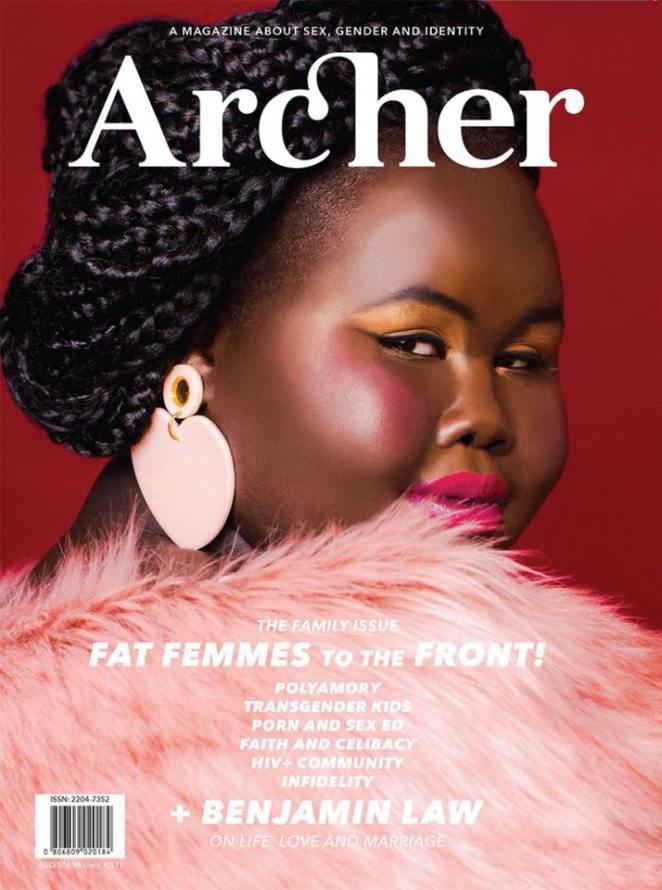
Archer Magazine 9

[image description: the cover of Archer Magazine’s Issue 9, depicting Abbey Mag, a beautiful black fat femme looking over their shoulder, wearing gold eyeshadow, pink lipstick, pink heart-shaped earrings and a pink faux fur shrug.]

I wrote an article for Archer Magazine Issue #9 about finding queercrip family and community. You can preview the issue here, or buy it here.

I’ll be reading an excerpt at the launch party, Wednesday 24 January at 6:30pm, at the Red Rattler Theatre, Marrickville. You can buy tickets here.

Join us for the launch of Archer Magazine #9 in SYDNEY!

A very special launch party to celebrate Issue #9: Family, and also celebrating Archer Magazine founder Amy Middleton’s last issue as editor before taking maternity leave.

$5 Ticket price covers cost of the event including venue hire, performers, speakers, and AUSLAN interpreters
$10 Ticket price covers event costs plus a small donation to Archer Magazine
$20 Ticket price covers event costs plus a copy of Archer Magazine #9 at the discounted launch price of $15 (magazine to be collected at the launch)

–Issue #9: Family–
Polyamory, infidelity, HIV and gay men, trans kids, fat femme visibility. We don’t mean the traditional kind of family, we mean the most important kind.

Come celebrate, connect with the community, grab a copy of the magazine and have a dance.

Venue: Red Rattler Theatre, 6 Faversham St, Marrickville.
The Red Rattler is a community run, accessible theatre space. Venue is wheelchair accessible, bathrooms are gender neutral. The event will be AUSLAN interpreted by Amanda Galea, with simple (no flashing/strobe) lighting, and quiet/dark spaces available. There will be breaks between each speaker for a chance to digest, and process. Any other accessibility needs, please contact Lucy, lucy@archermagazine.com.au

We acknowledge our event will take place on stolen land from the Gadigal people of the Eora Nation. We pay our respects to Indigenous elders past, present and future. Sovereignty was never ceded.

CRIPS AGAINST THE CAMPS

“crips against the camps” in red block capitals, “rally for manus refugees” in smaller white block capitals, on a black background

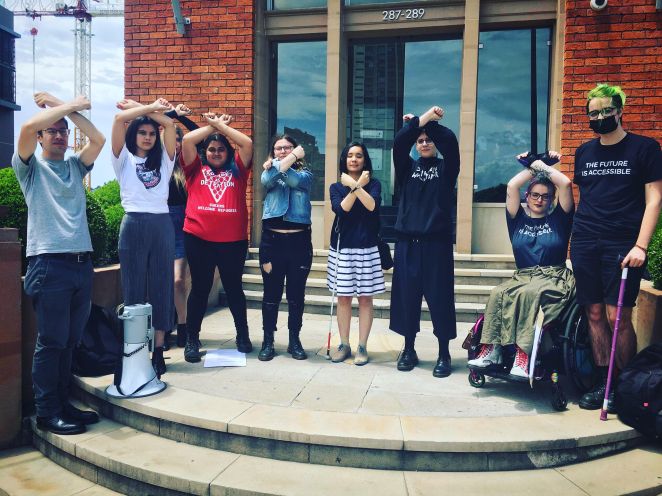
On Friday the 17th of November, the University of Sydney Disabilities & Carers Collective held a protest outside Prime Minister Malcolm Turnbull’s office, condemning the current refugee crisis and demanding the immediate evacuation of Manus Island.

We also delivered a statement & list of demands, which you can read below, or download as a word document here: University of Sydney Disabilities and Carers Collective Statement and List of Demands. You can also read it at the Disabilities & Carers Collective’s Facebook page here.

#EvacuateManus #CripsAgainstTheCamps

Crips Against The Camps protest

[image: eight young activists from the University of Sydney Disabilities & Carers Collective & Sydney Grassroots with their crossed arms raised at a protest outside Prime Minister Malcolm Turnbull’s office in Edgecliff. One is a wheelchair user, one has a purple cane, & one has a sight cane. There is a megaphone on the ground. Two of the activists (myself and my mate charlie) are repping Annie Segarra’s excellent THE FUTURE IS ACCESSIBLE shirts.]

University of Sydney Disabilities & Carers Collective Statement in Solidarity With Manus Island Refugees & Condemning the Ongoing Refugee Crisis

The University of Sydney Disabilities & Carers Collective acknowledges:

  1. (i) That Australia is a racist settler state built on colonial violence;
    (ii) that the founders of “Australia” also came here on boats and without permission;
    (iii) that sovereignty was never ceded and there is no treaty with our Indigenous peoples;
    (iv) that the Aboriginal Provisional Government and the Indigenous Social Justice Association have stated that asylum seekers are welcome on Aboriginal lands in Australia;
    (v) and that the false Australian government consequently has no right to refuse entry to refugees.
  1. (i) That the United Nations Convention Relating to the Status of Refugees, which Australia ratified in 1954, defines a refugee as someone who is unable or unwilling to return to their country of origin owing to a well-founded fear of being persecuted for reasons of race, religion, nationality, membership of a particular social group, or political opinion;
    (ii) that 90% of asylum seekers who come to Australia by boat have been found to be legitimate refugees under the UN Convention, even though the terms of the Convention itself are limited;
    (iii) that the Australian Government’s Department of Immigration and Border Control’s insistence on referring to legitimate refugees as “illegal maritime arrivals” and “immigration detention detainees” is dehumanising and disingenuous.
  1. (i) That according to Australia’s ratification of the United Nations Convention Relating to the Status of Refugees, this government has an obligation to provide aid to refugees fleeing persecution, regardless of whether Australia has processed their claim or recognised their refugee status;
    (ii) that the Convention must be applied without discrimination on the basis of race, religion, country of origin, sex, age, disability, sexuality, or other prohibited grounds of discrimination;
    (iii) that the Convention recognises that refugees are often forced to breach immigration rules and should not be penalised for entering or staying illegally, nor should their freedom of movement be restricted, and that prohibited penalties include charges of immigration or criminal offences relating to the seeking of asylum, or arbitrary detainment purely on the basis of seeking asylum;
    (iv) that the Convention stipulates that no one shall expel or return (“refoule”) a refugee against their will, in any manner whatsoever, to a territory where they fear threats to life or freedom;
    (v) that under the Convention refugees have rights including the right to access to the courts, to primary education, to work, and the provision for documentation, including a refugee travel document in passport form;
    (vi) and that according to the Convention Australia is currently failing its obligations to refugees.
  1. (i) That Nauru and Manus Island are deeply harmful environments;
    (ii) that refugees on Nauru and Manus and in onshore detention centres experience a disproportionate prevalence of PTSD, suicidal ideation, and self-harm, as a direct result of their retraumatising surroundings;
    (iii) that the Australian government has placed refugees in environments that have caused them to develop mental, emotional, and physical disabilities arising out of trauma and neglect;
    (iv) that the Australian government has consequently failed to provide adequate healthcare to refugees.
  1. (i) That forcible institutionalisation of marginalised peoples is detrimental to health, happiness, freedom, and autonomy;
    (ii) that the forcible institutionalisation of disabled people is not so different to the forcible institutionalisation of refugees, and in both instances leads to further traumatisation, abuse, and neglect;
    (iii) and that disabled people in our Collective and the refugees on Manus, Nauru, and in onshore detention, many of whom are disabled themselves, share a common struggle.
  1. (i) That potential healthcare costs of refugees and asylum seekers are not a reason to deny them aid;
    (ii) that the above argument is a deeply eugenicist position and one that is predicated on the assumption that the worth of a human life can be determined by how much a person costs the state;
    (iii) that the above argument perpetuates harmful narratives around health and healthcare that are deeply dangerous to disabled people;
    (iv) that the above argument violates the United Nations Convention Relating to the Status of Refugees’ protections against discrimination on the basis of disability;
    (v) that refugee lives have worth regardless of how expensive their medical bills are;
    (vi) that it is a community’s responsibility to care for each other;
    (vii) and that refugees are part of our community.
  1. (i) That Australia has a responsibility to the refugees placed on Manus Island and subsequently abandoned;
    (ii) that the “alternative accommodations” provided to the abandoned refugees on Manus are not safe or adequate;
    (iii) that the refugees on Manus have a reasonable fear of persecution and violence if they continue to stay in Papua New Guinea;
    (iv) that Papua New Guinea’s immigration department and chief of police have issued statements disavowing responsibility for the Manus refugees and have called on Australia to fulfil its legal obligations;
    (v) that to place refugees in the harmful conditions on Manus was a human rights violation to begin with, and that to abandon them there is not a solution to the harm of offshore detention processing, but rather a compounding of the violence and mistreatment directed towards refugees applying to Australia for aid in the face of persecution.

Consequently, the The University of Sydney Disabilities & Carers Collective demands:

  1. That the Australian government evacuate the refugees and asylum seekers presently on Manus Island, close the detention centre on Nauru for good, and bring all the refugees and asylum seekers to the place of their choosing, whether that be Australia or New Zealand;
  2. That all mandatory detainment of refugees and asylum seekers should cease immediately;
  3. That all refugees and asylum seekers should be released into the community, and be given justice, freedom, legal and medical aid, and proper humanitarian support without delay;
  4. That Peter Dutton, the current Immigration Minister, be sacked, for gross dereliction of duty, for perpetuating harmful misinformation about refugees, and for participating in a system that enacted dire human rights abuses;
  5. That all future legislative approaches to refugees and asylum seekers, in both the government and the non-government sectors, across local, regional, national, and international levels, be led by consultation with the refugee community and with Aboriginal and Torres Strait Islander peoples;
  6. That specific laws be implemented prohibiting the mandatory detention of refugees and asylum seekers;
  7. That the Australian government fulfil its obligations to the United Nations Convention Relating to the Status of Refugees, including providing refugees with freedom, settlement, and humanitarian resources regardless of the way in which they came here;
  8. That the Australian government implement strategies for proper humanitarian aid with regard to refugees and asylum seekers travelling to Australia in dangerous conditions, including maritime rescue operations;
  9. That refugees and asylum seekers should be reunited with their families in cases where they have been involuntarily separated;
  10. That the Australian government adopt policies of accountability and repatriation, including acknowledging the torture and abuse that has been enacted under the auspices of the Australian Government’s Department of Immigration and Border Control, and making amends to those who have been directly or indirectly harmed as a result of the traumatising system of mandatory detention, the provision of appropriate healthcare and community support, and that the refugees and asylum seekers who have been harmed as a result of Australian government policies should be compensated along with their families, and that compensation should also be given to families of those who have lost their lives after being deported or forced to self-deport to danger.
F R E E  O U R  P E O P L E !

Ratified by:

The 2017 Disabilities & Carers Collective Office-Bearers
Mollie Galvin, Hannah Makragelidis, and Noa Zulman

The 2018 Disabilities & Carers Collective Office-Bearers
Robin Eames, Mollie Galvin, and Ren Rennie